




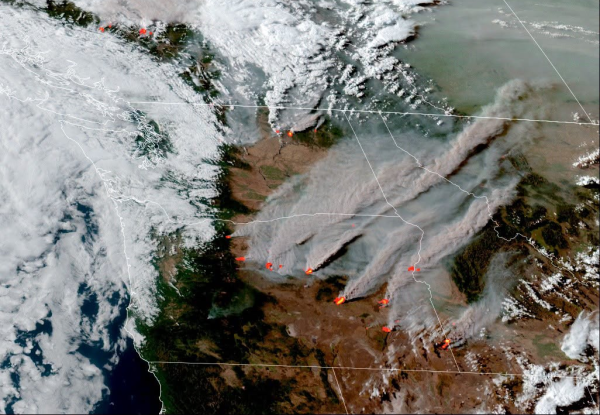
Smoke from wildfires, July 2026 via Washington Weather Chasers
Editor’s Note: This is the third in a series of articles this week on smoke impact in wine. Read the first article. Read the second article.
Below, I look at recent smoky vintages in the Pacific Northwest and discuss my perception of the resulting wines. Please note that I am quite sensitive to smoke impact, so what I’m noticing and what others notice might differ. I’ve also had a lot of experience over the years to get better at picking up smoke impact at varying levels.
Before getting into it, it’s important to note that smoke impact is not binary. Additionally, smoke during a vintage by no means indicates that there will be perceptible smoke impact on every wine produced that year. Finally, there are wide individual differences in sensitivity to detecting smoke impact.
2012 vintage
There was smoke in the Columbia Valley at times in 2012. I even wrote about it at the time.
Personally, I did not notice smoke impact on any of the 2012 wines on release. In fact, I consider 2012 to be one of the strongest vintages since I moved to Washington in 2000.
However, at that time, I wasn’t anywhere near as versed as I am now in detecting smoke impact. Going back to some of these wines in recent years, I have seen smoke impact on some of them.
I haven’t sensed any common theme. However, it’s clear to me that the smoke in 2012 did have an impact on some of the resulting wines. I’m less clear on when that impact became more apparent.
2015 vintage
The 2015 vintage also had smoke in the Columbia Valley. It was also an exceptionally hot year, the hottest on record at that time.
Again, I did not perceive smoke on the 2015 wines on release. However, I very much recall the wines being very brooding aromatically, monolithic, and having firm, and at times scratchy, tannins.
Knowing what I know now, that description sounds an awful lot like how smoke impacted wines present. I’ll be interested in returning to these wines to see whether there is any discernable smoke impact. I suspect that there will be on some.
2017 vintage
This was the first vintage where I personally noticed smoke on Columbia Valley wines in a significant way. There were two significant smoke events in 2017, one in August and one in September.
I noticed smoke impact on some rosés, particularly Cabernet Franc and Mourvèdre, some white wines, including all Pinot Gris, and some red wines, particularly Cabernet Franc, Mourvèdre, and wines with a significant amount of Petit Verdot.
A very large percentage of the entry tier wines I tasted were impacted, as much as 40%, though the levels on some were low. This could be for a variety of reasons. It could be due to when the grapes went through veraison. It could also be that the harvested material contained a higher amount of MOG (material other than grapes, such as stems and leaves). It could also be a combination of factors.
A substantial percentage of higher tier wines also showed some level of smoke impact. The impact varied from
Please login below to see full content or Subscribe Now to get immediate, full access to our ratings and reviews, review database, featured articles, and other subscriber-only content.


Leave A Comment