




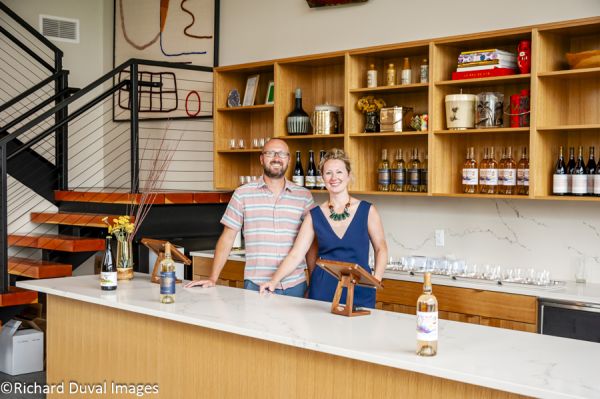
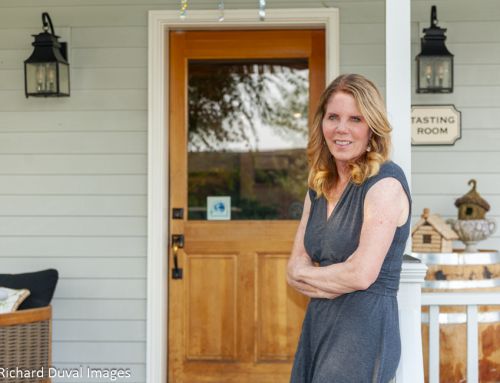
Matt and Kelly Austin, Grosgrain Vineyards, Walla Walla by Richard Duval
“What’s exciting about Washington is that it’s still a relatively young region for wine,” says Matt Austin, owner and winemaker at Grosgrain Vineyards in Walla Walla. “It’s fun to be able to put your stamp on the area as far as trying to discover some new things.”
In a short time, Grosgrain Vineyards has unquestionably made its mark. Grosgrain is producing some of the most distinctive and exciting wines in Washington. They are, generally speaking, somewhat lighter-bodied, fresher, and see less new oak. The winery is also known for exploring and championing what it calls “underdog” varieties. In fact, it’s become a calling card.
“I think it’s definitely helped us stand out,” Austin says. “Every year, we’re trying new things. We’re doing something a little different, something that a lot of younger consumers are getting excited about.”
“I was looking for something to grab me”
Many have heard about how the 2004 movie Sideways raised Pinot Noir’s fortunes and lowered Merlot’s. However, the movie had other impacts: It turned a lot of people on to wine. Austin was working as an attorney and his now-wife Kelly was a fashion designer. They saw Sideways on a date.
“We didn’t know much about wine at the time, but we loved the movie,” Austin says. “Since we lived in Los Angeles, not far from Santa Barbara [where much of the movie takes place], we decided to go wine tasting and had an amazing time.”
On the trip, Austin talked with several winemakers. The conversations made an impression. Almost immediately thereafter, he decided to learn all he could about wine.
“Having been a musician in the past, I’ve always been someone who has a creative mind,” Austin says. “I got a lot of the same inspiration with wine, as far as the expression and creativity with it, as I felt in music.”
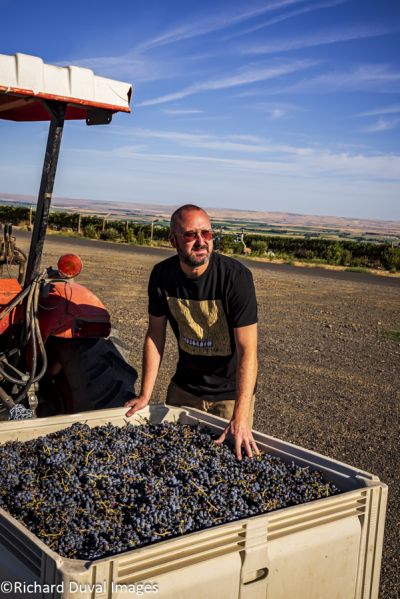
Matt Austin, Grosgrain Vineyards by Richard Duval
A Michigan-born, Florida-raised guitar player into punk and indie music, Austin knew that he needed a backup to his dream of becoming a musician. He decided he would try to become a lawyer in the entertainment industry. However, filesharing and on-line music in the early aughts quickly shrank opportunities.
Austin subsequently worked in different fields of law, including criminal law and litigation. He ended up a tax attorney but never quite found his niche.
“I was looking for something to grab me, and wine definitely did that,” Austin says.
Taking a leap of faith
In Los Angeles, Austin lived by an influential wine shop called Silverlake Wine. This was during the beginnings of the ‘new California wine’ movement, and the shop was full of such offerings.
The Austins started visiting other wine regions beyond their home base. Kelly grew up in Redmond, Washington, making the state’s wines and wine regions obvious choices. With Kelly wanting to be closer to family, in 2014 they made a radical move. The couple both quit their jobs and moved to Seattle.
Austin went back to school, taking classes at Northwest Wine Academy. “That was how it all began,” he says of his winemaking career.
Given his interest in lighter, fresher wines, Austin was directed by an instructor to talk to Michael Savage at Savage Grace Wines. A Northwest Wine Academy attendee, Savage pioneered a fresher, lighter-bodied, earlier release style in the state. Soon, Austin began interning at the winery.
Looking to explore different production styles and techniques, Austin subsequently interned at EFESTĒ in Woodinville under winemaker Peter Devison. (Devison later started Devison Vintners.) After finishing school, he became assistant winemaker at nearby Darby.
However, Austin longed to be closer to the vineyards. To get there, he applied to jobs all over the U.S., including wineries in California and New York. In 2017, he accepted a job as cellar master at Dunham Cellars in Walla Walla, Washington.
Sudden vineyard owners
When he moved to the town, Austin expected it would be some time before he even considered starting his own winery. That changed almost immediately.
Kelly saw an advertisement in the local paper for a small vineyard at a bankruptcy auction. The auction was that day. While Matt was working, Kelly looked at the property and saw its potential. The couple put in a low bid and suddenly found themselves vineyard owners.
 Grosgrain’s property is in the southside winery district near the Oregon border. The five-acre site had two acres of vineyards and a house, which was in disrepair.
The Austins restored the house, which is now a vacation rental, and built a winery and tasting room. Grosgrain’s tasting room features Kelly’s design aesthetic, informed by a midcentury theme, and a beautiful outdoor space.
In the vineyard, the Austins kept existing plantings of Aglianico and Nebbiolo, two unusual varieties for the valley. Other vines were beyond saving and were replanted to Grenache and Carignan. Grosgrain Vineyards opened its tasting room in spring, 2019. (NB: A historical note, I was Grosgrain’s first customer.) Pronounced ‘grow-grain,’ the winery is named after a textile pattern in a callout to Kelly’s former work.
“Thinking outside of the box”
Back to the underdog variety part of our story. From the outset, Austin intended to do things differently.
“We definitely wanted to get a little outside of what people were familiar with,” Austin says. “I think a lot of it’s my punk rock background. I was always drawn to wineries that were thinking outside of the box.”
In addition to lighter, fresher wines made from lesser known varieties, Austin also wanted to focus mostly on estate fruit. Specifically, he was interested in grapes from Walla Wala Valley, though the winery also sources from other areas.
“I’ve just always found there’s a certain depth that you get in Walla Walla fruit compared to a lot of other regions,” Austin says. “There’s a certain energy to the acidity in the wines.”
Grosgrain subsequently established a vineyard in the southern section of the valley. The site is higher in elevation and persistently windy, which slows development.
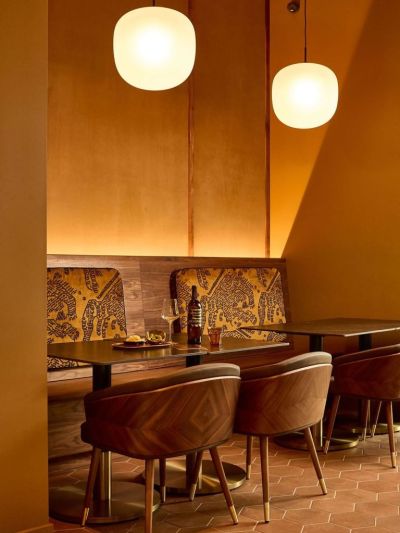
Grosgrain interior, Harvest Woodinville
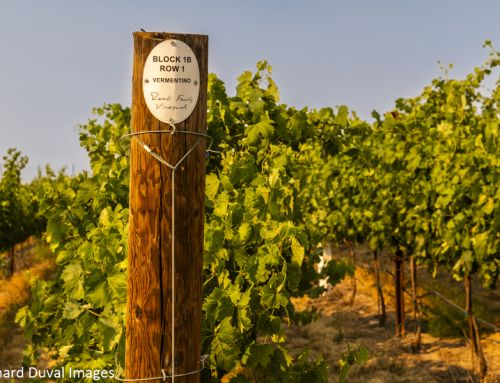
True to the winery’s calling card, Grosgrain planted a wide assortment of varieties. They include Albariño, Vermentino, Fiano, Ribolla Gialla, Xarello, Macabeo, Grenache, Syrah, Mourvèdre, Cinsault, Carignan, and Cabernet Sauvignon.
“There’re varieties I really love that we can use to make lighter, more fresh-style reds,” Austin says. “We also wanted to have a lot of options for blending to make the top expression of the site.”
Finding inspiration in exploration
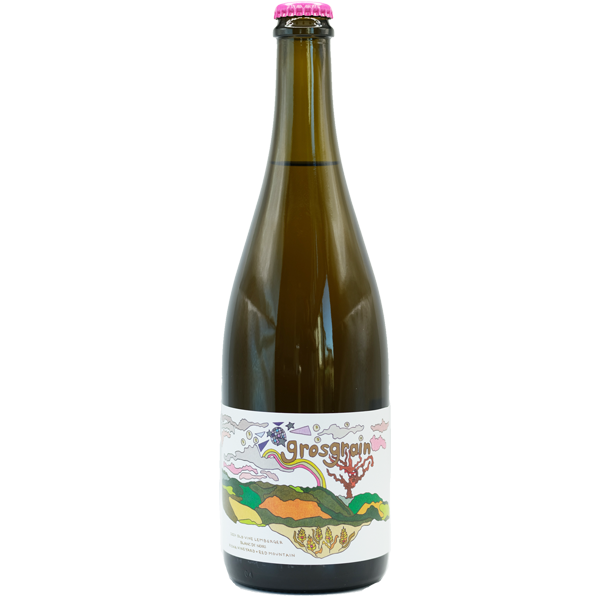
Grosgrain Vineyards unquestionably has its own voice in terms of the wine it produces and the varieties with which it works. For example, one of the inaugural releases was a sparkling wine made from old vine Lemberger on Red Mountain, a region known for its big, bold reds. Some wines also fall into the chillable red category that I wrote about recently. Many are accessibly priced.
There is also, as noted, plenty of exploration. Grosgrain made an astonishing five single vineyard Grenache in 2024. Such site exploration is common for Syrah in Washington but is almost unheard of for Grenache.
“It’s been the variety that’s really gotten me inspired the most,” Austin says. “It’s pretty fun how strikingly different they each are.”
In addition to its winery in Walla Walla, Grosgrain recently opened a tasting room in Woodinville in the new Harvest development. Overall, the winery is thriving. While Grosgrain started out with its own style, it’s one an increasing number of Washington wineries are exploring.
“I think there is momentum toward dialing back ripeness in the vineyard,” Austin says. “There’s obviously still a lot of really powerful wines made in Washington, but I think a lot of people are rethinking ripeness and the use of oak. I think more restraint is being seen across the board from a wide variety producers.”
Northwest Wine Report needs your support. If you haven’t already, please subscribe. Northwest Wine Report is 100% subscriber funded. This site can’t continue to exist without your support. To those who have subscribed, thank you! You power this site.



Leave A Comment