




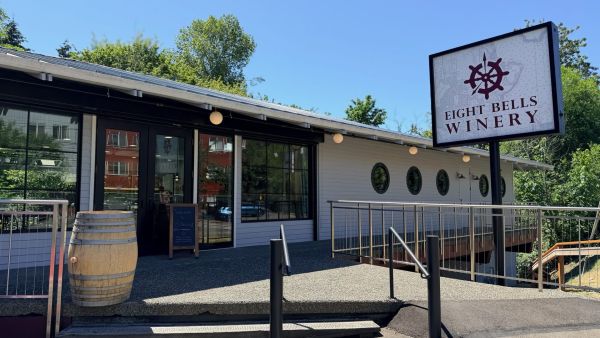
Eight Bells Winery, Seattle, WA courtesy of winery
“You can’t get this anywhere else,” Taylor Nordby, CEO and partner at Eight Bells, says of the winery’s new location. “We want to be an urban winery with appeal, and this is a very special spot that no one even really knows exists.”
Last year, Eight Bells moved from Seattle’s Roosevelt neighborhood to nearby Meadowbrook. The winery’s new location – 10000 Lake City Way Northeast in Seattle, affectionately referred to as “10K” – is unassuming from the front. However, the building offers much more than meets the eye.
A hidden building and an urban oasis
An astonishing 38,000 cars pass by Eight Bells Winery each day. Surely people in every one of them would think Eight Bells is a simple, single floor business. In fact, the building has three floors and is built into a hillside.
Former owner Stan Baker constructed the building in 1987. He ran Stan Baker Sports, which included a mill shop where he did a unique rifling technique for shotguns on the top floor.
“He wanted to present the building on Lake City Way as a one-story building,” says winery co-founder Frank Michiels, Nordby’s father.
Why the visual deception? On the second floor, Baker kept cars, high-end, expensive cars of the sort one wouldn’t want passersby to notice.
“He would keep an eye out for cars in Italy that got into accidents and needed work, and he’d import them, strip them down, then build them back up,” Michiels says. “That was just a hobby of his.” Meanwhile, Baker, one of his employees and ultimately his son lived on the ground floor, illegally according to city records.
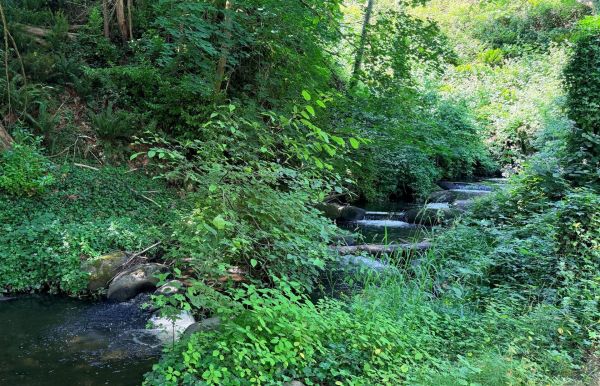
Thorton Creek by Eight Bells, courtesy of winery
The backside of the 10K building also has something that no one driving by would ever expect: a large greenspace. Thorton Creek, complete with salmon spawning pools, runs through it. It is a green oasis in a heavily urban area that instantly makes one feel as if they have been transported outside the city.
Built for wine production
The fact that the 10K building has three floors is a big part of its appeal to Eight Bells.
“It’s like it’s built for wine production,” Michiels says.
During harvest, fruit is brought in on the exterior of the top level. Grape bins are emptied into the destemmer on the second floor, where production takes place. Barrels and tanks full of wine are then fed via gravity flow to the bottom floor for bottling. This level also has case storage.
As Baker was working on cars on the second floor, the second floor production area has no posts. Rather, it is supported by large beams spanning 40 feet. This makes it easier to forklift and transport barrels and other items. On the bottom floor, three of the walls are in earth, keeping temperatures 58 degrees year-round, ideal for wine storage.
Often when people construct their own buildings, they cut corners. Not so with Baker.
“He was a perfectionist,” Michiels says. “He put in special pilings down to the bedrock. The building is almost 40 years old, and it has not settled one inch. You look at all the concrete work, and it looks brand new.”
Adding efficiencies
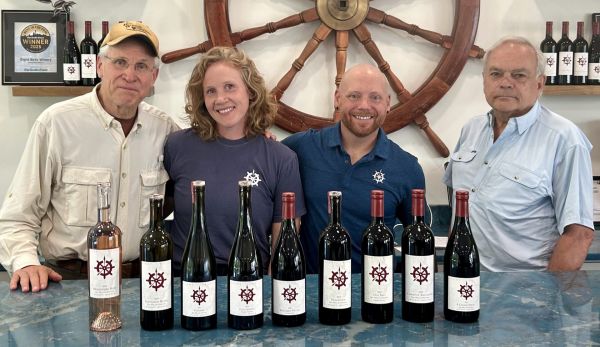
L to R: Frank Michiels, Taylor Nordby, Tyson Teese, Tim Bates.
Eight Bells’ location in the Roosevelt neighborhood, which was about two miles away from its current location, was exceedingly modest. The 2,600 square foot space served as a tasting room and production center. The winery creatively utilized every square inch.
“We were a winery in a closet,” Michiels says. As a result, concessions had to be made.
One was case goods storage. After bottling, pallets of wine were trucked to a storage facility and then ultimately back to the winery as needed.
“By the time we sold a bottle to a customer, we’d touched it 15 times,” Michiels says.
At its new location, the bottling line is set up on the ground floor next to steel cages made in France specifically for wine bottle storage. Wine comes off the bottling line, is put into a steel cage, and then later is taken by elevator up to the tasting room as needed. Bottles are now touched a total of three times.
With its wine stored in cages, Eight Bells now largely uses cloth bags instead of cardboard boxes. Customers are asked to bring them back for re-use.
“We should take advantage of the fact that we are a micro winery,” says Michiels, with Eight Bells Winery producing approximately 2,500 cases per year. “95% of our wine is sold directly to our customers.”
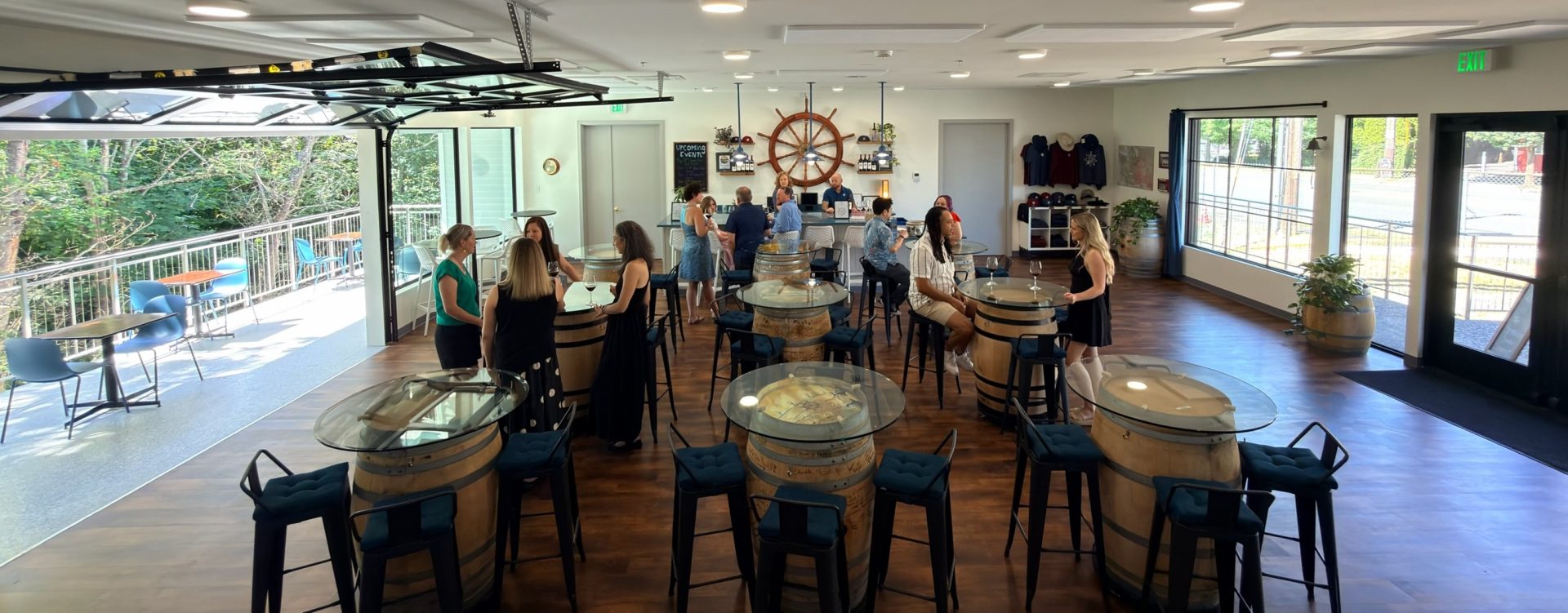
Wheelhouse tasting room at Eight Bells Winery, courtesy of winery
Positioning the winery for the future
Eight Bells is named after eighth bell that rings when a sailor’s watch is over. The winery’s top-level, customer-facing floor leans into this nautical theme.
The Wheelhouse is the main tasting area. The side facing Lake City Way has portholes for windows. The opposite side of the top floor has two decks overlooking Thorton Creek, both easily accessed through roll-top doors. Opposite the tasting bar is a chart wall, with large format historical charts of Seattle and the Puget Sound from the early part of the 20th century. Other rooms include the Wardroom for small, private tastings and the Captain’s Quarters.
“It’s night and day compared to our last space,” Nordby says. “It’s completely transformed our opportunities and the level of creativity we can exercise.”
Eight Bells spent over 16 years in “a closet.” Now, it is in a proper winery building that has a rich history and positions the winery for the future. All the while, Eight Bells Winery remains true to its roots.
“One of the main things we didn’t want to deviate from was being a true Seattle urban winery with a small, neighborhood feel,” Nordby says. “We still have that.”
Northwest Wine Report needs your support! This site is 100% subscriber funded and is my primary source of income. If you haven’t already, please subscribe now. To those who have subscribed, thank you! This site would not exist without you.

How interesting!