




 How can you get more out of every bottle of wine that you open? It’s easy.
Here are three things that will dramatically increase your enjoyment of wine.
1. Drink from quality wine glasses
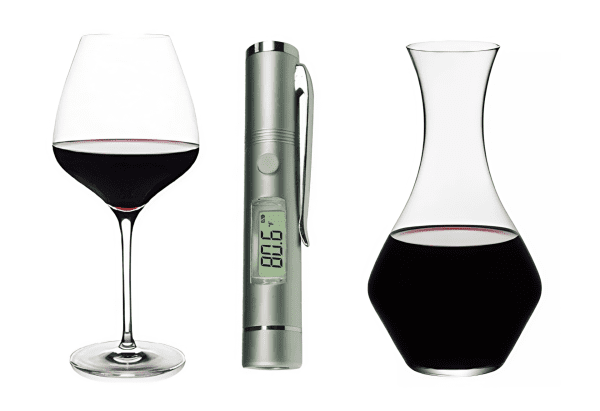
Nothing affects the enjoyment of wine as much as the shape of the glass that you are drinking from. Wine glasses have several impacts. One is to concentrate aromas and flavors. A second is to focus where the wine lands on your palate. Wine glasses also impact the aesthetic experience.
In terms of glasses, there are innumerable options. In fact, if you’ve got limitless budget and endless cabinet space, you could buy different glasses for every major variety type. (Note: Very few people do this.)
Personally, I recommend glasses that are tulip-shaped. This helps focus aromas and flavors.
If you want to see what a difference good wine glasses make, set up an experiment. Try smelling and drinking a wine from a water glass and a tulip-shaped wine glass. The difference is profound.
Some glasses that I personally recommend are the Schott Zwiesel Forté Tritan Crystal glasses. (Note: That is not an affiliate link, and neither are any of the links below.) These are my workhorse glasses. They are not indestructible, but they are hardy. I also use The One wine glass for Rhône varieties (red and white) and for aromatic clarification.
For expensive options, which I really only recommend once you are comfortable washing stemware without breaking it, I recommend the Zalto Universal. For sparkling wine, I love the Josephine No. 4. Both do an excellent job amplifying aromas and flavors and enhancing the aesthetic experience.
2. Enjoy wine at a proper serving temperature
Temperature profoundly impacts the overall perception and enjoyment of wine. If a wine is too cold, aromas shut down. Red wines seem considerably more oaky. If a wine is too warm, the alcohol shows more, and wines can seem flabby. To me, anything 70 degrees or above is way too warm for red wines. (Yes, I’m the guy who puts ice cubes in my glass pour wines at restaurants.)
Personally, I recommend drinking red wines at 62-66 degrees Fahrenheit. This is cool, but not cold, to the touch. For white wines, I generally recommend 55-60 degrees.
To get there, you can put the wine briefly in the fridge or freezer. How long depends on the ambient temperature and the other factors. For white wines, if they are in the fridge, I usually take them out a period of time before to let them warm up before serving. Again, how long depends on the ambient temperature.
I also recommend using something to check the bottle/wine temperature. I personally use a gauge like this.
As time has gone on, I’ve tended to enjoy red wines on the cooler end of the 62-66 degree scale and white wines on the warmer side of 55-60, if not even a little warmer. With something to gauge temperature, you can see what temperature seems best to you.
3. Decant young wines
As I wrote recently, generally speaking, we all could stand to decant young wines, both red and white. This provides oxygen and opens them up. It helps smooth tannins and brightens aromatics.
Almost all young red wines, assuming that they are above, say, $20, can benefit from decanting. Less expensive wines are typically already made in a style for maximum enjoyment popping and pouring.
Again, you don’t need an expensive decanter, though one can be part of the aesthetic experience. Even a water pitcher will do.
* * *
Now, do you need to do these things to enjoy wine? Of course not. However, overall, I guarantee that these three things will dramatically improve your experience with wine.
If you want a fourth, share a bottle of wine family and friends. Doing so can be one of life’s most memorable and rewarding experiences.
To receive notifications about new articles via email, click here.
Do you enjoy Northwest Wine Report? If you do and haven’t already, please subscribe. Northwest Wine Report is 100% subscriber funded. To those who have subscribed, thank you! You power this site.

Another way to slightly cool down a wine a few degrees is to chill, or even freeze the glass beforehand. That way you don’t have to drop an ice cube and water it down, although I still do that all the time too.
Sean-
Couldn’t agree more with your three choices.
I’ve often heard use an aerator on young wines and decant wines 5+ years old. Is this incorrect info?