




 The wine industry seems to have confused making wine more accessible with dumbing down everything to its lowest possible point.
Recently, I wrote about three things people can do increase their enjoyment of wine. These were simple things: use tulip shaped wine glasses, don’t drink wine too hot or too cold, and consider decanting using any vessel available. On my Facebook page, I received some pushback that articles such as this create barriers that are part of the problem in today’s (and yesterday’s) wine industry. To that, I strongly disagree.
Part of enjoying wine, certainly if one is talking about luxury-priced wines which we are here in the Northwest, can be about education and storytelling. It can be about how to more fully appreciate what is in one’s glass. It can be about the people, the places, and the vintage. This should be an open door that is inviting enough that everyone feels comfortable to walk through it if they want, but entrance is not required for enjoyment.
As an industry, we must not – must not – abandon the role of education and storytelling. They are central parts of creating lifelong wine lovers and advocates.
If we say that we shouldn’t talk about things that can enhance one’s enjoyment of wine, that these things don’t matter out of fear of creating barriers, then, truly, nothing matters, right? Buy whatever is the cheapest thing on the shelf that is still sufficiently agreeable to your palate.
Don’t get me wrong. I do believe that wine content can, intentionally or not, create barriers that make people less likely to drink wine. What do barrier articles look like?
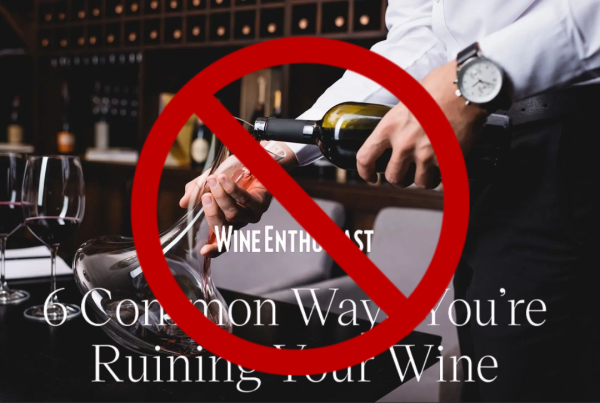
Wine Enthusiast provided an excellent example in its recent social media promotions. (Note: I was a contributing editor at Wine Enthusiast from 2013 to 2022.) The article is titled, “6 Common Ways You’re Ruining Your Wine—and How to Fix.”
The title of this article, in and of itself, creates barriers. It might as well say “Six ways you’re drinking wine wrong.” In fact, some of the sub-sections say exactly that. (My emphasis in bold.)
You’re drinking your wine at the wrong temperature
You’re serving it in the wrong glassware
You’re overfilling your glasses
You’re storing it improperly
You’re unsure when to decant
You’re not considering food pairings
Make no mistake, this article and those sub-section titles are intended to shame and embarrass people. It is a highly negative way to get a point across. (It must be mentioned that Wine Enthusiast sells solutions related to most of the things that it is shaming readers about.)
Note that this article talks about some of the very same things that I wrote about in my article: stemware, temperature, and decanting. However, the tone is completely different. My article was titled, “Three things you can do…” I did not say must. I did not even say should.
The Wine Enthusiast article, in contrast, quite literally tells people that they are ruining their wines by not doing these things. This is, of course, complete and total nonsense.
As an industry, we should embrace having an open doorway that provides opportunity for people who want to learn more about wine. We should encourage talking about wine’s special place in agriculture, history, and society. We should encourage storytelling and education. We should work to lower barriers and be mindful of the tone of content and discussion.
But avoid telling people about ways to increase their enjoyment of wine? Sorry, no. Lowering barriers does not mean dumbing down wine and avoiding talking about ways to increase enjoyment. That is self-defeating.
Do you enjoy Northwest Wine Report? If you do and haven’t already, please subscribe. Northwest Wine Report is 100% subscriber funded. To those who have subscribed, thank you! You power this site.


1000% agree. Letting people know how they could better enjoy wine should never be looked at negatively. But shaming is more of a marketing thing than a genuine attempt to educate. If I make you feel bad enough, you’ll buy the thing I sell to fix the “problem” you didn’t know you had a few minutes ago.
I’ve been lucky enough to do a glassware tasting and the most eye opening part of the experience was when we were told to pour a wonderful WA cab from the Rattlesnake Hills from a Bordeaux glass into a plastic cup. The aroma and taste immediately went to zero. Same wine, different glass, opposite experiences. That said, I think we’ve all had wine out of a plastic cup at a tailgate or on a boat before and that’s ok too, just maybe don’t waste your time stressing over WHICH red to open in that situation since there won’t be much of a difference :)
I completely agree with you on this.
I was just on a media wine press trip and there was a writer who was blathering on about the glassware not being “proper.” Yes, glassware makes a difference, but not anywhere near as large a difference as the quality of the wine itself. More to your point, it induces doubt into the reader about whether their $5 wine glasses are good enough. I don’t want to drink wine out of a jelly jar (though I did at a too-hip-for-its-own-good restaurant), but any decent wine glass will do. The point should be to be an Enthusiast, not a Doubt Creator.
Blake, agreed. To me, it’s really about the shape of the wine glass more than anything else. Something to help focus aromas.
Some years back now, I bought my brother a set of inexpensive wine glasses for his birthday ($10/stem). Both he and his wife said that it completely changed how much they enjoyed their wine. Are they likely to buy more wine as a result? You bet.
Great article. I’ve been articulating most of your points for years. Thanks