




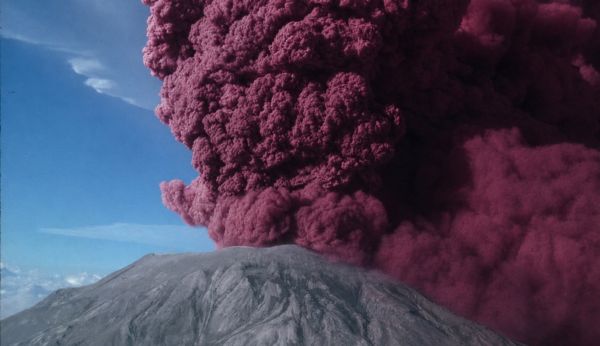
 In recent years, “volcanic wines” have received a great deal of press. There can be varied definitions, but one is wines made from vines grown on soils with volcanic parent material. Common examples are wines from Mount Etna and Sicily.
Many assume Washington wines are volcanic, given the state’s towering strata volcanoes, most notably Mount Rainier. The reality, however, is considerably more nuanced.
Almost all of the Columbia Valley’s bedrock is volcanic
First things first. The Columbia Valley is Washington’s largest grape growing region and encompasses most of the state’s other viticultural areas. Almost all of the Columbia Valley and greater eastern Washington’s grape growing regions have volcanic bedrock.
In almost all areas, that bedrock is Columbia River Basalt. These massive basalt flows took place 17 to 6 million years ago. The basalt belched from fissures in the earth, as opposed to eruptions from strata volcanos.
There are regions of the Columbia Valley and greater eastern Washington where there is something other than basalt bedrock. However, almost all of these areas have bedrock that is volcanic in nature too. (Editor’s Note: One area that does not have volcanogenic bedrock is the Rocky Reach appellation.)
However, in almost all areas, vines do not interact with volcanic bedrock
While the bedrock throughout the Columbia Valley is volcanic, in most cases, there are thick soils on top of that bedrock. The soils are so thick that, again in most cases, vines will never interact with the underlying bedrock. These overlying soils are generally not volcanic.
As mentioned previously, Washington does have numerous strata volcanoes. Over the course of time, there have been eruptions. For this reason, one can find layers of volcanic ash in various places in the Columbia Valley. Surely these are volcanic soils, right?
Sort of. These ash layers are generally very thin in most places. Therefore, their overall effect relative to the other soils is minor. That said, there is ash. In places, vines grow deep enough to interact with it.
Some places do unequivocally have volcanic soils
There are places in the Columbia Valley and broader eastern Washington where vines do interact with volcanic material. They are as follows, going from specific areas to more general ones.
1. The Rocks District of Milton-Freewater
The Rocks District of Milton-Freewater is a nested appellation of Walla Walla Valley and broader Columbia Valley. It is entirely on the Oregon side of the valley. This area is an ancient riverbed, made up of fist-sized basalt cobblestones. Basalt is, again, volcanic material. The vines interact directly with the basalt cobblestones. (Read more about the Rocks District here.)
2. The North Fork of the Walla Walla River
The North Fork of the Walla Walla River in Walla Walla Valley has gained attention with some winegrowers in recent years. In this area, vines are planted on shallow soils above fractured basalt. Examples include Hors Categorie Vineyard and Elevation Vineyard. Force Majeure and Valdemar Estates recently planted vineyards in this region as well. The resulting wines certainly fit the definition of volcanic. Again, this area is entirely on the Oregon side of the valley.
3. Lake Chelan
The Lake Chelan appellation is at the opposite end of the Columbia Valley from Walla Walla Valley. Due to its proximity to Glacier Peak, a strata volcano, the Lake Chelan appellation has a sizable amount of pumice and ash in its soils. Vines planted there interact with these components.
4. Parts of the Columbia Gorge
The Columbia Gorge abuts but is outside of the Columbia Valley. Within this area lies Underwood Mountain, an extinct volcano. Wines grown on and around Underwood Mountain would be considered volcanic. There are also volcanic materials in soils in some other areas of the Columbia Gorge, particularly in the west.
5. Vineyards and parts of vineyards where soils are very shallow
There are other specific vineyards or parts of vineyards where soils are shallow and vines have the opportunity to interact with bedrock. One such example is L’Ecole No. 41’s Ferguson Vineyard in Walla Walla Valley. This is a site where the soils get very shallow at the ridgeline. In other areas of this vineyard, however, soils are deep enough that the vines would never interact with the basalt.
Take home message
Volcanic wines are having a moment, and there is certainly an angle to tell for Washington wine. Overall, however, Columbia Valley wines should not, as a rule, be considered volcanic wines.
That said, there are plenty of areas in the Columbia Valley and broader eastern Washington that do meet the definition. It’s more a question of where specifically the wines are from and what one considers a volcanic wine. We’ll leave for another day how this volcanic material might, or might not, impact the resulting wines.
This article has been updated.
Editor’s Note #1: After this article was published, Marty Clubb, co-owner and managing winemaker at L’Ecole No. 41, noted in a personal correspondence that the average soil depth at Ferguson Vineyard is two to three feet. Clubb stated that all vines at the vineyard would therefore interact with basalt.
Editor’s note #2: See a related article from my time at Wine Enthusiast about the myth that the Columbia Valley has “rich volcanic soils.”
Do you enjoy Northwest Wine Report? If you do and haven’t already, please subscribe. Northwest Wine Report is 100% subscriber funded. To those who have subscribed, thank you! You power this site.


Adding this note from Christian Grieb (Treveri Cellars), which he posted to the Northwest Wine Report Facebook page:
“6) The Naches Heights sits on top of the Goat Rocks volcanic lava flow. Many places the soil is very thin and vines consistently interact with this unique andesite flow. Many of our rock cropping’s jetty out from the soil and nestle in amongst the vines.”
* * *
For those unfamiliar with the area, Naches Heights is a nested appellation of the Columbia Valley north of Yakima. Almost all of the appellation is on Tieton andesite. This is volcanic rock from a lava flow from the Goat Rocks volcano 1M years ago.
So Naches Heights very much has volcanic bedrock and falls into the statement above: “There are regions of the Columbia Valley and greater eastern Washington where there is something other than basalt bedrock. However, almost all of these areas have bedrock that is volcanic in nature too.”
I wasn’t aware of the thin top soils in many locations in Naches Heights, so I don’t personally have sense of whether it would fit more into my #5 or whether the whole appellation should be listed separately. I do expect that there are numerous vineyards with shallow topsoils throughout in eastern Washington. It’s more a question of whether this is enough of a defining feature of an area to call it out separately on this list. For Naches Heights, I need to do additional research.
Thank you Sean for a very well done and accurate accounting of the actual facts of the matter of ‘volcanic soils’: Kudos to you!
More than 25 years ago I was a research soil scientist and geologist at WSU and part of a team investigating the physical and biological reasons that the soils of eastern Washington and north central Oregon were (and are) so poorly aggregated and, as a result, highly susceptible to wind erosion. The reasons for concern were the massive dust storms and the damaging impacts of fine particulate matter on human health when breathed in (now classed as PM2.5, an acronym for ‘particulate matter less than 2.5 microns in diameter’).
Our team took about 150 samples of soils from all across the region and analyzed them for their contents of volcanic ash (tiny glass shards from eruptions of Cascade volcanoes).The thinking was that the content of volcanic ash in the soils, if high, might inhibit the normal good aggregation processes typical of non ashy soils.
WELL! With just a few exceptions, the average content of volcanic glass across the entirety of eastern Washington and north central Oregon was, as I recall, only about 3 or 4 percent! The remainder of the mineral fraction of the soils was more than 80 percent sand and silt particles derived from crystalline rocks in the source areas of glacial grinding of granites and related crystalline rocks in the Canadian Rockies that fed the Missoula Floods.
So much for ‘volcanic soils’!
Now please, let me add on more ‘exception’ to your list of areas in the PNW with volcanic soils:
On the Oregon side of the Columbia Gorge and in areas from Mosier, The Dalles,and, in a massive arc that forms a giant eroded volcanic-alluvial fan complex extending from The Dalles to Dufur Oregon and beyond, the bedrock is soft volcanic sandstone more than 2000’ thick that form the canyon country in that part of the Cascade foothills.
Geologists have named this the ‘Dalles Formation’ or ‘Dalles Group’. This volcanic pile consists of volcanic mudflows and bouldery debris flows erupted between about 10 and 8 million years ago from an ancestor stratovolcano (or volcanoes) to Mount Hood that were centered to the west of that active volcano. The volcanic edifice (‘cone’) or cones, whose eruptions over 2 million years or so built the ‘pile’, have eroded away.
Vineyards in this area such as Three-Mille Vineyard and my own Windhorse Vineyard have vines that are rooted in soils weathered from volcanic ash and lithic volcanic sands. Vineyards like these that are above about 800 feet escaped backflooding of Missoula outbursts into valleys such as Three Mile and Mill Creek and so their soils are not formed of flood debris.
The soils at 3-Mile and Windhorse and others at higher elevations, however, DO HAVE a cap of wind blown loess, which has a texture of silt loam. This ‘cap’ is typically about 12 to 18 inches thick and was derived from dust storms reworked out of slackwater sediments over the post-glacial period from about 12,000 years ago to the present.
Nevertheless, the rooting zone of grapevines at elevation in this area is dominated by weathered volcanic loams and sandy loams. Volcanic soils!
One final note: vineyards below about 800 feet in the Mosier-Dalles-Dufur area, such as the beautiful Garnier Vineyard astride Interstate 84 at Mosier have soils derived from various Missoula-flood gravels, sands, and slackwater silts. Garnier itself is planted on a mega-flood sand bar that has been partly reworked into sand dunes by strong westerly Gorge winds over the same post-glacial period.
Alan, thank you for the kind words, excellent information, and great addition to the list!
Sean, we need to get you up to Naches Heights — truly a unique WA AVA.
Paul, agreed! We’ll definitely make it happen.
Anytime, just let us know when works for you.
Great article. Here in Western Washington on the Key Peninsula we had our soils tested and they contained significant volcanic ash. 16C and 24D are the two primary soils with 16C being the largest. What does this mean for our vines?
My daughter and son-in-laws farm between Benton City and Prosser has a canyon in it that has an exposed approx. 6 foot thick layer of ash (rock)! According to GROK it is about 11.7 myo and originated from the Yellowstone Hotspot when it was located between Bruneau ID and Jarbidge NV! We also had to bust up several hundred square feet of semi fractured basalt that was covered by about a foot of Starbuck silt loam to get their small vineyard planted! The Yakima Reach/Badlands area is quite varied and probably quite unique!