




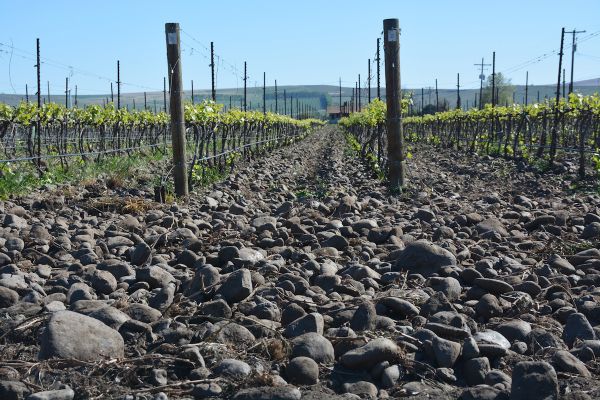
 The idea that the area’s cobblestones retain heat at night is a myth
Some wine regions take on certain mythologies. So it is with the Rocks District of Milton-Freewater. This area routinely receives wine writer attention, and deservedly so. The wines can be of stratospheric quality. However, many get a key aspect of the area wrong.
The Rocks District of Milton-Freewater is a nested appellation of Walla Walla Valley which is, itself, nested within the larger Columbia Valley. Wholly on the Oregon side of the border, the appellation is distinct in that 96% of its soils are made up of a single soil series: Freewater very cobbly loam. (Read a feature article on the Rocks District.)
The area is an ancient riverbed of the Walla Walla River. The ground is made of up fist-sized basalt cobblestones, derived from the nearby Blue Mountains. These cobblestones are then covered, or not, with windblown sand and silt.
Christophe Baron (Bionic Wines) planted the first modern-day vineyard in this area in 1997. In an oft-told story, Baron was visiting Walla Walla Valley and showed a friend a book with a picture of Châteauneuf-du-Pape’s famed cobblestones. His friend said that such an area existed in Walla Walla Valley. Shortly thereafter, Baron established his first vineyard there. (Read previous feature articles about the Rocks District I wrote for Wine Enthusiast and Washington Tasting Room Magazine.)
The wines from Baron’s Cayuse Vineyards quickly became highly regarded for their earthy and savory elements as well as their exceptionally high quality. In the ensuing decades, numerous other growers planted vineyards in the area. The Rocks District of Milton-Freewater received appellation status in 2015. Offerings from the Rocks District truly taste unlike any other wines on Earth, though there are similarities to wines of the Northern Rhône.
It’s clear that the basalt cobblestones in the Rocks District influence grape growing and the profile of the resulting wines. However, many writers – and even some locals – say that this is due to the stones absorbing heat during the day and then slowly releasing it at night.
This is not true. Anyone who has ever spent time backpacking or camping by a river could tell you that this doesn’t pass the sniff test. If you pick up a stone by a riverbed after the sun’s gone down, the stone is cold. How cold? We even have an expression for it: stone cold.
The cobblestones in the Rocks District do absorb heat during the day. Basalt is dark-colored and iron-rich.
What happens, however, is that, during the day, these stones radiate this heat in the infrared back at vines and grape clusters. The impact is greatest if the vines are trellised lower to the ground and if the cobblestones are fully exposed with minimal soil or cover crop. The stones also transfer heat into the soil and roots.
As the sun sets, however, the stones cool down and become quite cold, again, stone cold. Yes, they retain heat for a short period, but the impact in terms of viticulture is minor. The process of heating up and cooling then repeats the following day.
So, yes, Rocks District wines are very much impacted by the basalt cobblestones in the region. However, the impact is by and large what happens during the heat of the day. The idea that stones retain heat and release it at night is a myth.
Do you enjoy Northwest Wine Report? If you do and haven’t already, please subscribe. Northwest Wine Report is 100% subscriber funded. This site can’t continue to exist without your support. To those who have subscribed, thank you! You power this site.



As a retired horticultural researcher who spent 30 years working with various food crops, including grapes, and who now has a small vineyard in The Rocks AVA, I’d like to respond briefly. Grapevines are probably the most responsive of all the crops I worked with over the years. Just like us, they are alive and their responses to conditions and management are extremely complicated. I am a firm believer in the power of terroir but a skeptic toward what many say terroir is. Suffice it to say, The Rocks has a rich terroir when in comes to grapes and heat is just one element of that terroir. It is very easy to oversimplify why the wines of The Rocks AVA are so good. And I agree, they really are.
Williplantsman, there’s definitely a lot more going on in the Rocks District than just the cobblestone soils and heat in terms of how the wines present themselves. If I gave an impression otherwise, that was definitely not my intent.