




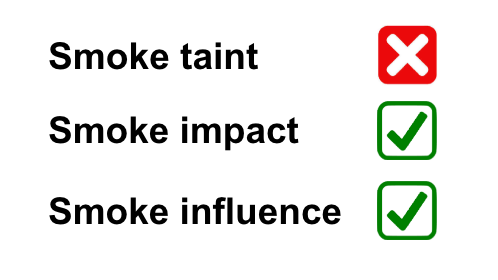
 Smoke impact is not binary
(Editor’s Note: This is the last in a series of articles about smoke impact in wine. Read the first article. Read the second article. Read the third article. Read the fourth article. Back to our regularly scheduled program next week.)
With another round of wildfires this year in and around various wine regions, there’s been a steady stream of articles about smoke taint. The industry needs to stop using that term outside of extreme cases.
Smoke taint implies that smoke’s impact on wine is binary. That is not true.
Smoke influence can have a range of sensory impressions, from extremely subtle to quite overt. Individuals also have a wide-range of sensitivity to perceiving smoke influence in wine. Additionally, as many as 20% of people are said to be essentially anosmic to detecting smoke impact. It begs the question, if a wine is impacted by smoke but it is at such a level that only a laboratory analysis can detect it, it, is it still ‘smoke tainted’?
Finally, there is no agreed upon set of analytics by which one can reliably say that a wine is so significantly impacted by smoke as to be ruined, outside of extreme cases. Talking with people at The Australian Wine Research Institute, the world leaders in the study of smoke impact on wine, they would say that analytical data cannot say if a wine is so significantly smoke impacted to be a problem. They can only say what the risk profile looks like.
So, what’s a better term than the yes/no ‘smoke taint’? Personally, I prefer using the terms smoke influence or smoke impact. This is a way of saying, “I perceive this wine to be impacted or influenced by smoke.” Then I break it down further.
When tasting wines for review, I rate how impacted a smoky wine is in terms of aromas and flavors on a 0-3 point scale in half point increments. Based on this, I have buckets of what I call low, medium, or highly impacted wines.
Do I consider ‘highly impacted’ wines to be ‘smoke tainted’? Yes, to my palate. ‘Low impact’? No. How might my perception relate to how someone else perceives the wine? There’s no way of saying at present.
If one looks at the range of wine flaws and faults, contamination with trichloroanisole (TCA), commonly referred to as cork taint, almost stands alone as being universally regarded as faulted at any level. For others, like volatility, oxidation, brettanomyces, etc., there’s subjectivity to how objectionable or not an individual finds it. There’s also a range of how high the impact must be before most people would regard the wine as faulted.
Such is the case with smoke. Using the terms smoke influence or smoke impact leaves room for these nuances. Calling every smoke impacted wine smoke tainted does not.
Equally importantly, using the term smoke taint creates the impression that any amount of smoke influence on a wine corresponds to the wine being ‘tainted.’ If the industry continues to give that impression, there will be serious repercussions.
So, consider using the terms smoke impact or smoke influence. Let’s leave ‘smoke taint’ for the most extreme cases, understanding that, even then, what seems tainted to you might not to others.
To receive email notifications about new articles, CLICK HERE.
The Northwest Wine Report Fall Subscriber Drive has started! If you’re not already a subscriber, please consider subscribing now. It’s the only way that this site will be able to continue publishing in 2027. See the number of new subscribers still needed on the top right of the site. Click on the button below to subscribe.


Leave A Comment