




 How western Washington’s wine hub germinated in the seediest of places
Woodinville’s Warehouse District is about as far away from traditional visions of wine country as any wine lover could imagine. Run-down, shabby, prefab warehouse buildings are surrounded by a sea of sun-bleached asphalt. As if to further lessen the experience, a clutter of sandwich board signs and buildings with letter designations are often the only hope of a newcomer finding any particular winery.
“It’s certainly not on par with the great châteaux of Bordeaux,” quips Chris Sparkman, who started his Sparkman Cellars in the region in 2004. In fact, it’s not even on par with the chateau on the other side of town.
Ste. Michelle Vintners purchased a sprawling, 118-acre Woodinville property formerly owned by lumber baron Frederick Stimson in 1975. The winery built a chateau so stately that even French vintners would feel at home, and upon opening in 1976 as the first winery in Woodinville, rebranded itself to Chateau Ste. Michelle. The entire industry has felt its gravitational pull ever since, with Ste. Michelle then and now the state’s largest winery.
Today, Woodinville is home to more than 130 wineries and tasting rooms, and there is no doubt that is because of the seed Ste. Michelle planted on its tony grounds. But it is a few miles to the north, in Woodinville’s decrepit warehouses, that an entire industry blossomed, like a patch of pure green grass springing up from a crack in the pavement.
“Every week I could stay open was a win.”
“Mark is the key to this whole place,” says Erica Orr, owner of Erica Orr Winemaking Consulting and Orr Wines, of the Warehouse District. “He’s the godfather of Woodinville wine.”
Mark is Mark McNeilly, founder of Mark Ryan Winery, the 19th winery in Woodinville. Toweringly tall, reminiscent of a tightly trimmed Hagrid from Hogwarts, McNeilly worked in the restaurant industry as a server and also as a wine distributor and wholesaler. After years of home winemaking, he founded his winery and made his first commercial vintage in 1999, bouncing around to various locations the next few years.
There were a handful of warehouse wineries in Woodinville prior to 2003 when McNeilly arrived. But the area’s fortunes forever changed when Mark Ryan Winery moved into an office park with an unassuming name and an address more fitting of a business in an urban metropolis than a winery in a 28,000-person Seattle satellite: Woodinville Park North, 19495 144th Ave NE, Building B-210.
“I knew how important [Woodinville] was just because of how much winemaking muscle there was there,” McNeilly says of what drew him to the town. There were more practical reasons too.
“It was something we could afford,” recalls Jerry Riener, who was McNeilly’s right-hand man from 2003-2009. “We were just driving around looking for signs that said ‘For Rent!'”
Winemaking is too often romanticized. In reality, many days it can have more in common with janitorial work than high art. Making wine in an 1,800-square-foot, run-down office-park warehouse would quickly disabuse most people of wine-life illusions.
Not McNeilly. Like a cartoon character whose legs are a blur of motion before they start actually running, McNeilly kept working harder and harder, desperately trying to set his young winery into motion.
“In those days, I was so close to going out of business,” he says. “I felt like every week I could stay open was a win.”
“Holy shit. I might be able to make this work.”
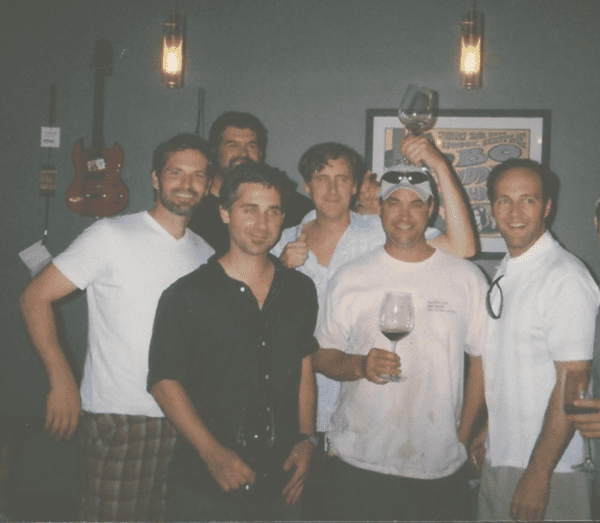
Left to right, Darby English, Mark McNeilly, Chris Gorman, Tim Stevens, Chris Sparkman, and Jerry Riener in 2009.
Selling wine is not easy. In the early aughts, many wineries in Woodinville would open only twice a year for special events that were rallying points for the nascent industry. One such event was Passport to Woodinville, held the first weekend in April.
With a growing pile of unpaid winery bills, McNeilly opened his doors for the 2003 event. He was greeted by a line of people stretching up the hill and around the corner waiting to taste his wines.
“I was about ready to start balling my eyes out when I saw all those people, recalls McNeilly. “I thought ‘Holy shit. I might be able to make this work!'”
That weekend event would also inspire others. One of them was Darby English, who would go on to found Darby Winery.
“I thought it was the coolest thing ever,” English says of the event. “So many people. The buzz was cool. The wines were awesome. I thought in the back of my mind ‘I want to get into the wine business!’”
Meanwhile Riener, who has a degree in organic chemistry and is equally facile with a forklift, was indispensable in getting Mark Ryan launched. As payback for his contributions, McNeilly had a proposition.
“He said to me ‘We’re starting your winery,’the mo” Riener recalls. Riener made four barrels of The Rookie Cabernet Sauvignon in 2003, which would become his first wine for Guardian Cellars.
Around this same time, Chris Sparkman, who was working as a general manager at a high-end restaurant in downtown Seattle, asked the duo to help him get started in the wine business. In 2004, McNeilly and Riener made 12 barrels of wine for Sparkman as consulting winemakers. Two years later, Sparkman opened his eponymous winery in the same complex.
“Everybody used everbody’s everything.”
These were not UC Davis-trained winemakers. There was also a paucity of winemaking programs in Washington at that time, and knowledge was limited.
“The professionalism was sometimes lacking, and the knowledge was really nonexistent,” says Riener. “It was Let’s just try this. That included everything from working on equipment to making the wine to all the paperwork we had to do.”
Any knowledge gained was quickly shared. The same went for purchased equipment.
“Everybody used everybody’s everything,” Sparkman recalls of the cooperative spirit that defined the Warehouse District’s early days. “We took a lot of pride in the fact that we’re so collegial”
While the cooperativity helped, it also meant winemakers could only use equipment when others were not. That made for many late nights and early mornings.
“I’d work, get out [to the warehouse] at eight at night, and process fruit by myself until one or two in the morning,” says English, who opened Darby Winery in the Warehouse District in 2006. “I’ve slept in the warehouse so many times, in a sleeping bag on top of pallets.”
While English was sleeping on pallets, Riener was living an even less comfortable existence. In 2006, he was ready to launch Guardian Cellars, but there was only one problem: he lacked funds. So he sold his house to help pay for it and moved into a 900-foot space carved out of his newly rented warehouse next to Mark Ryan. The only shower, however, was next door.
“Everybody would be driving into work and some guy in a towel is walking out of one warehouse into another,” Riener says laughing. He would live there for two years.
“There were a lot of sleepness nights.”
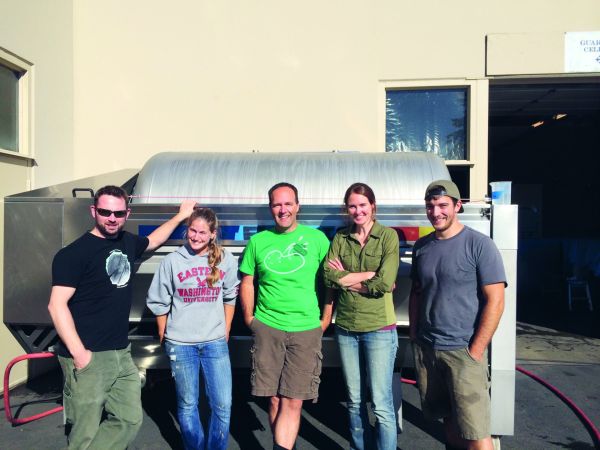
Warehouse residents Linn Scott, Lisa Repp, Jerry Riener, Erica Orr, and Joel Wright hang in front of a press in 2014
This near fanatical devotion was emblematic of the early warehouse wineries, with everyone working day jobs and making wine at night in near-fever dreams.
“That kind of raw passion was there,” says English. “You could see it in everybody’s eyes, that drive and that excitement. But also being scared. ‘Oh shit. We’re doing this!'”
That fear was real. The wineries assumed five if not six figure debt making wine that they wouldn’t sell for another two years. The following year, they’d have to do it all over again.
“There were a lot of sleepless nights, waking up at three in the morning, like, ‘What the fuck am I doing? Is this gonna work?'” English recalls.
After moving up from California in 2005, Orr opened a laboratory and winery consulting business in the warehouse area in 2006. She did so at McNeilly’s urging.
“He was my advertising and PR,” says Orr. “That’s how I got my clients.”
Suddenly, the Warehouse District could offer something no other location in Washington could. There was a critical mass of small, tight-knit wineries with an on-site laboratory.
Winemakers no longer had to wait multiple days for results from a lab in California, or just forego such information completely. They could have it in hours from a laboratory within walking distance or a short forklift drive.
“When Erica Orr showed up in Woodinville, that’s a line in the sand for when wine quality increased across the board,” says McNeilly.
“We can hatch as many of these eggs as we want!”
All of a similar age and working side by side, many in the area became close friends. “Every day I’d get a text from Mark to go down there and play ping pong,” says English. “We were all going through that same moment, just that energy and that drive. None of us had kids at the time. It’s the funnest time I’ve ever had in the industry.”
Things started to happen quickly. One winery opened in the area. Then another. Then another. Wineries were popping up left, right and center, with the warehouse buildings as incubators. Many of these young wineries also had early critical success.
“We thought ‘My God. We can hatch as many of these eggs as we want!’” says Riener.
For wine lovers, the suddenly bustling warehouse wineries offered a unique vibe. These were true garagistes, bootstrapping boxy buildings into winemaking production centers. New wineries were constantly opening up, with eager consumers waiting at their doorstep.
“All you had to do was throw an A-board out and you were the new guy,” says English.
Visiting warehouse wineries also offered consumers a literal pulling back of the curtain. One could walk into a zero-frills warehouse space – save perhaps some white lights hung for the occasion or a black curtain to hide equipment – see where the wines were made, buy new releases on the spot, and meet and talk to the winemaker.
There was something else that added to the area’s special appeal.
“If I may be so bold, the wine quality is there,” says Orr. “You also don’t have to be a Forbes billionaire to start your own winery. These are regular folks that have day jobs.”
“You have to move stuff out, move stuff in every day.”
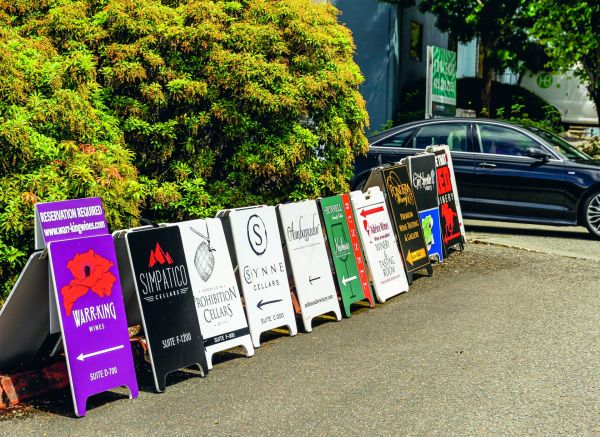 Over time, the number of wineries in the Warehouse District swelled, with another warehouse area (at times referred to as Artisan Hill) with Stevens Winery and others a few minutes away offering even more. As it did, the district took on an increasingly bizarre feel.
Permanent signage is not allowed on the main road-way, so scores of A-frame sandwich boards lined the streets to point people in the right direction. Wine lovers enjoyed the close proximity of numerous wineries, but so did people looking to party, with the area’s density making for easy winery-hopping.
“It was nuts,” recalls English. “We had so many people at times we had to put someone at the door to stop letting people in.”
Some wineries also began to feel the discomfort of making wine in a space that was not designed for it. Ceilings in the warehouses are only 11 feet high, greatly limiting barrel and case goods stacking. Many of the spaces are also a mere 24 feet wide and an odd 70 feet long.
“You’re packed to your gills, and you have to move stuff out, move stuff in every day,” says Chris Gorman, who moved his Gorman Winery into the Warehouse District in the mid-2000s.
Traditional wineries also have a crush pad, a flat, covered area next to the winery where winemakers process grapes prior to fermentation. In the case of the Warehouse District, this process takes place in the parking lot, at times in the rain. All of the equipment moved outside to process fruit needs to be moved back into the winery at night.
There were other challenges too.
“We were on a pretty extreme hill,” says Gorman. “We had to truck strap our press to the building so it didn’t roll down the hill and kill someone.”
“Everyting was about making do.”
Due to their small size, the warehouses also limit how much wine can be produced within any individual space. As wineries increased production, they had to find additional warehouses. Some hopscotched over to larger buildings. Others just added another warehouse. Gorman was fortunate enough to ultimately have three contiguous warehouses. Sparkman was less so, with three non-contiguous spaces.
“It was perhaps one of the most inefficient winemaking models ever,” he says.
“The buildings, everything was just wrong,” admits Riener. “Everything was about making do, not built for efficiency in any way.”
As demand for space in the area increased, so did costs. With more wineries looking to get into the area than there were buildings, upkeep by landlords was minimal.
“I was there for 14 years, and I don’t think they ever fixed anything,” says Gorman.
When the Great Recession hit, numerous Eastern Washington wineries also began opening tasting rooms in the area. Suddenly, some of the warehouses were no longer a peak behind the production curtain – they were satellite tasting rooms in shabby warehouses for wineries located elsewhere in the state.
Meanwhile, for the out-of-towner who came to the area expecting to see rolling hills of verdant grapevines, there was frequent confusion. Most of Washington’s vineyards actually lie a hundred or more miles to the east.
“People would call and say ‘I think I’m lost. I just see warehouses. Where are the grapes?'” laughs Lisa Baer, owner of Baer Winery, which moved into the area in 2007. Some wine lovers were thrilled by the gritty vibe and high quality wines they found. Others were puzzled.
“The Warehouse District is here to stay.”
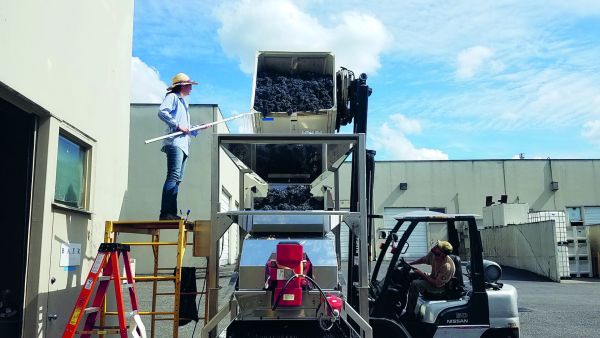
Erica Orr processing fruit in the Woodinville Warehouse District
Over time, most of the early wineries that started out in the region – The Originals as they refer to themselves – started to look for larger spaces elsewhere. Mark Ryan moved production to a warehouse in nearby Kirkland and then eventually to an even larger space in Walla Walla, though the winery maintains a tasting room in Woodinville.
Gorman and Guardian moved into newly constructed buildings in nearby Maltby in 2019. In 2020, Sparkman moved into a spacious facility the winery renovated near Chateau Ste. Michelle. Some of the early wineries, however, remain in the Warehouse District.
“For us and our size, just around 3,000 cases a year, it still makes sense,” says Baer. “There’s that support and infrastructure. Customers still enjoy it.”
The Warehouse District continues to flourish. Occupancy is near 100% – the vast majority filled by wineries. The spirit of cooperativity established in the area also remains.
“The Warehouse District is here to stay – that’s no question,” says McNeilly. “It’s an incubator to some extent. They are a great opportunity for people that want a small wine project that they can do their full-time job and do this as well.”
Other parts of Woodinville have evolved, too. In the decades since Ste. Michelle opened its chateau, an entire industry has sprung up. In addition to the Warehouse District, multiple other tasting areas have been established more recently, from the Hollywood area to downtown and beyond.
Though The Originals are now a diaspora, the group remains close and gathered after Ross Mickel of Ross Andrew Winery died in a plane crash in 2022.
“There is this special bond those that were The Originals have that’ll never go away,” says Sparkman. “We didn’t realize how special those times were because we were so naive and so idealistic. We had no clue of what we were getting ourselves into. We were just hanging out, drinking beer, watching grapes mash.”
Today, one in every eight wineries in the state is either located in Woodinville or has a tasting room there. Dozens of them remain in the warehouses. Many of the state’s top wineries continue to blossom there, in the most unlikely of places.
“We were the right people on the wrong side of the tracks,” says Riener of the original wineries. “It was a bunch of us that didn’t have a lot of money, but we had the heart and the desire to do it.”
It was fun reading this again. These guys were much of the inspiration for us to begin Pondera’s winemaking journey in 2005. We are still in the Warehouse District, now in our 21st year and we work together with our neighboring wineries to promote our collective of almost 30 established and new members, now called The Warehouse Wineries. And believe it or not our landlord has made some improvements! We’d love to see you do an updated article Sean. Cheers
Loved the article Sean. Thanks for sending
I realize that not everyone can be mentioned here, but not a word about John Patterson? He helped a lot of the smaller wineries by offering his hand with “Custom Crush” he had equipment that others didn’t and I believe he had an impact of helping to make the warehouse district such a great community, not competition, but lifting each other up. Especially the smaller producers.
I agree wholeheartedly. Personally, I think about the early warehouse wineries in a series of waves.
The first wave was a small group of wineries that I have not written about here but hope to if I can carve out the time. The second wave, for lack of a better term, was the ‘Mark Ryan Wave.’
Rightly or wrongly, I see Patterson as part of the wave after that. There is no question that he had a substantial impact on many wineries that subsequently moved into the warehouse area.
Such a great community, I was a regular visitor to most of these wineries back then, making many lasting friendships with winemakers and tasting room personnel
Good history of the area and start of the Warehouse District. Woodinville Wine Company (not mentioned) was the starting place for some of these wineries. The area some call Artisan Hill is also Warehouse wineries and had early wineries like Betz, and Steven’s and Chatter Creek.
Sean, indeed! If I can carve out the time, I’m hoping to write that story at some point as well.