




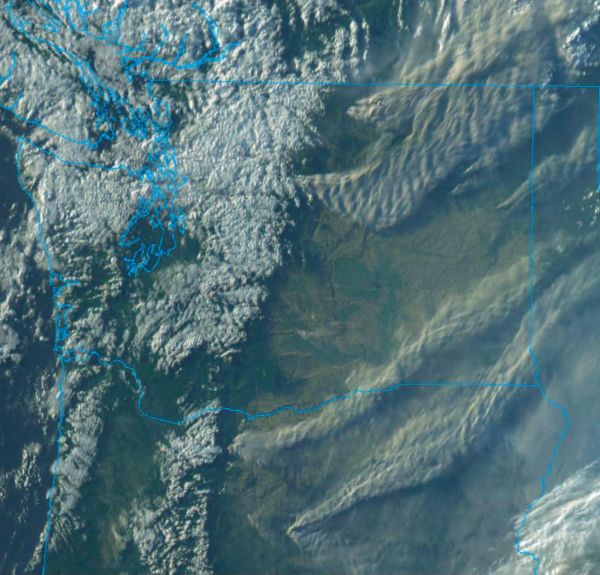
Satellite image of WA and northern OR via Washington Weather Chasers. Note clouds over western areas and large smoke plumes, blowing west to east, in eastern areas.
Spokane Complex Fire causes massive damage
This has already been a challenging wildfire season in the Pacific Northwest. However, things took a significant turn for the worse over the weekend.
The Spokane Complex Fire burned thousands of acres and an estimated 700 structures, including numerous homes. It forced the evacuation of approximately 60,000 people according to the Seattle Times. It is said to be the worst disaster in Spokane’s history.
Washington’s governor declared a state-wide wildfire emergency Saturday. This included a ban on most outdoor fires and agricultural burning until September 30th.
Powerful winds over the weekend led to a Red Flag Warning over most of the Columbia Valley. This fire weather warning is issued by the National Weather Service when there are warm temperatures, very low humidity, dry fuels, and strong winds. This weekend, for parts of eastern Washington and Oregon, these warnings were issued at their highest level: Particularly Dangerous Situation (PDS). It was the first time a PDS warning has been issued for wildfire threat in Washington state.
Near the Lake Chelan Valley, the Little Giant Fire has burned over 30,000 acres. Some parts of the Lake Chelan south shore and north shore, away from the main population centers, are under evacuation orders. Some Chelan-area wineries closed their tasting rooms over the weekend; others remained open.
In recent weeks, numerous wildfires in northeastern Oregon have driven smoke into Walla Walla Valley. There have also been issues with occasional wildfire smoke in parts of Yakima Valley and the Columbia Gorge this season. A change in wind direction today is expected to pull wildfire smoke across most of eastern Washington and into the Puget Sound area.
This wildfire season had a very early start. There have been various wildfires in eastern Washington and in some other regions of the Pacific Northwest since the beginning of June.
As bad as this year has been to date, the height of wildfire season is just beginning. August is typically very warm and very dry. Much of eastern Washington and parts of Oregon are also experiencing drought conditions.
Last year was also warm and dry with similar drought conditions. However, many areas of the Pacific Northwest escaped dealing directly with wildfires and wildfire smoke. A significant exception was the Lyle area of the Columbia Gorge.
This year, however, is a different story. Washington currently has over a dozen large wildfires burning more than 200,000 acres. There are 30 large wildfires in Oregon that are not yet contained, most in the eastern part of the state. According to ABC News, more than 1.7M acres have already burned in Oregon this year.
As always, the intensity and impact of wildfire smoke specifically is highly dependent on which way the wind blows. It is possible for one area to be inundated with smoke and another nearby area to be completely smoke-free.
Editor’s note: Our hearts go out to all of the people impacted by wildfires and wildfire smoke this season and in prior seasons.
Do you enjoy Northwest Wine Report? If you do and haven’t already, please subscribe. Northwest Wine Report is 100% subscriber funded. This site can’t continue to exist without your support. To those who have subscribed, thank you! You power this site.


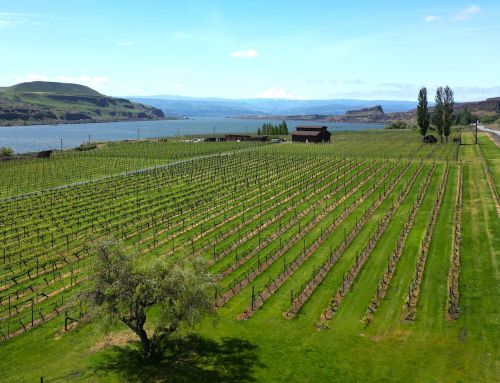

While the fires in the Lake Chelan area are about twenty miles up the lake, the direction of the winds has a great deal to do with the smoke levels from day to day and even hour to hour. One of our wineries has a web cam showing actual conditions here: https://silverbellwinery.com/visit#weathercam. At our winery, Amos Rome Vineyards, we employ MERV 13 air filters year round that eliminate all odors, particulates, virus/mold particles etc. so the inside air is pure. For most of the year that’s just so that people can taste without having any other odors compete, but when it’s smoky that means people can come inside the tasting room and breathe clean air. We stay open every day.
It also looks like the entire grape growing area of the state is impacted by the smoke. If the grapes are well into veraison that’s a bad thing. Time will tell, but smoke taint is going to be an issue for many wineries.
Finally, for your readers, if you decide not to come visit tasting rooms due to the smoke, maybe you can help them out by placing an online order. It looks like it’s going to be a tough month for many during what is peak visit time.
Tom, so sorry that you, your family, friends, and your business have been dealing with this in recent weeks and years. Everyone in the state will be affected by the fires and smoke shortly I’m afraid.
As you write and as I noted in my article, it’s all about which way the wind blows. I’m reminded of 2022 when there was a fire near Skykomish. The wine blew this smoke directly at Seattle, and we had poor air quality for three weeks in October. My brother, who lives just to the north of Seattle, had no issues whatsoever. If that wind had blown at Columbia Valley, it would have ruined the vintage. In that case, it didn’t.