




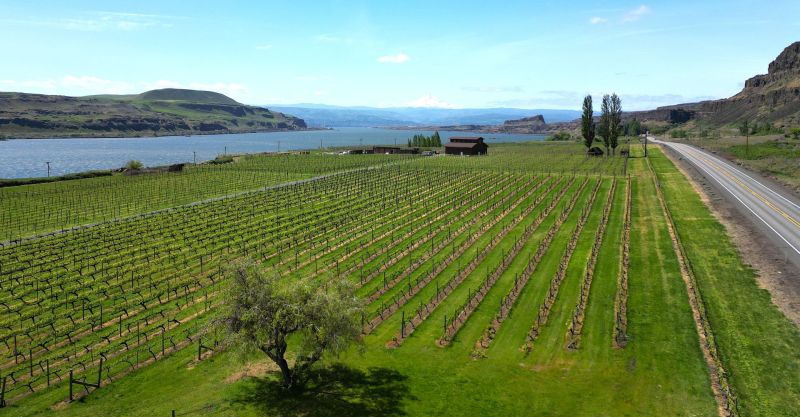
Cascade Cliffs Vineyard, Columbia Hills
Columbia Hills was approved as Washington’s newest appellation August 17th. Washington now has 22 federally approving grape growing regions. (See a complete list of Washington’s appellations with detailed information about each.)
Here’s a breakdown of must-know information about the Columbia Hills.
Who
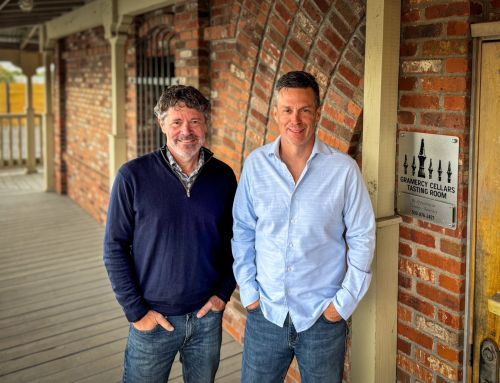
The appellation petition was submitted on behalf of Robert ‘Bob’ Lorkowski, owner of Cascade Cliffs, a winery located within the region. Geologist Kevin Pogue, owner of VinTerra Consulting, authored the petition.
There are four wineries within the Columbia Hills appellation. They are Cascade Cliffs, Maryhill Winery, Waving Tree Winery, and Jacob Willams Winery.
What
The Columbia Hills is named after a 35-mile ridgeline that parallels the Columbia River. The ridge is a Yakima Fold Belt structure, like many of eastern Washington’s other grape growing regions. These are most easily thought of as ripples in the landscape.
The Columbia Hills is wholly contained within the larger Columbia Valley and is 29,387 acres in size. Elevations range from 74 to 1,050 feet above sea level.
There are approximately 338 acres planted to grape vines. The largest vineyard within the appellation is V75 Vineyard at 78 planted acres. It is planted predominantly planted to Cabernet Sauvignon (64%). Other sizable vineyards in the area include Cherryhill and Maryhill. There are a number of smaller vineyards as well.
Where
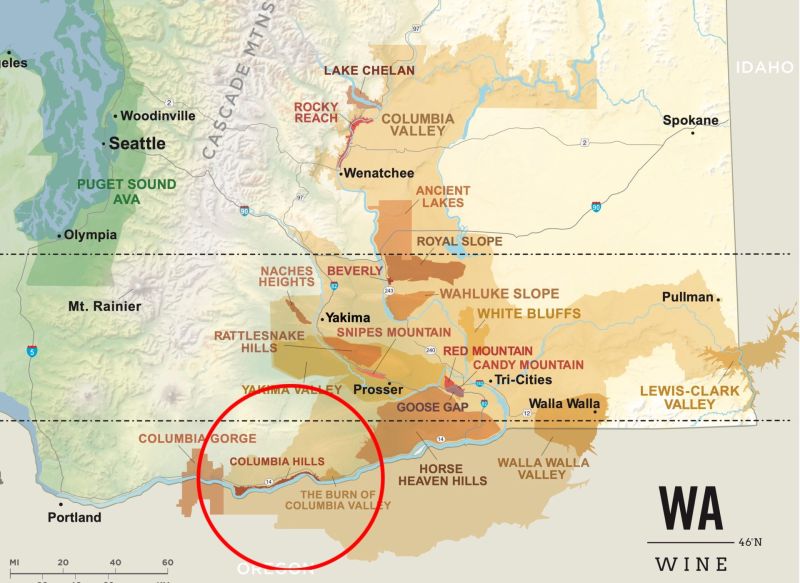
The Columbia Hills is located in south-central Washington. It is between the Columbia Gorge appellation, two miles to the west, and The Burn of Columbia Valley appellation, 0.33 miles to the east.
The Columbia Hills form a ridgeline between Rowena Gap and the mouth of Rock Creek. The Columbia River is the southern border of the appellation. The northern border is the 1,050 foot (320 meter) elevation line.
The northern border is the highest level reached in this area by the Missoula Floods, a series of cataclysmic Ice Age floods responsible for soils and other features of many areas of the Columbia Basin. This elevation is substantially below the Columbia Hills ridgeline, which averages 2500 feet above sea level.
Why
There are four key distinguishing characteristics to the Columbia Hills as a growing region. The first is the generally south-facing aspect of the area. This maximizes sun exposure.
On these slopes are a series of stepped terraces, caused by erosion from the Missoula Floods. These terraces create flat ground suitable to viticulture.
The second distinguishing feature is the appellation’s proximity to the Columbia River. Fully 80% of the appellation lies within a mile or less of the Columbia River’s shores. The river’s thermal mass has a profound moderating effect on temperatures in nearby areas.
Specifically, proximity to the river results in warmer temperatures throughout the growing season. This is particularly true in the morning. There is also persistent wind. The warming effect of the river and the impact of the wind extend the growing season.
“There are probably spots in the Columbia Hills that have the longest growing season east of the Cascades,” Pogue told Northwest Wine Report.
The third key aspect of the Columbia Hills is that the appellation is generally low-lying. Elevations range from 74 feet to 1,050 feet above sea level. There are numerous vineyards planted at the lower-end of these elevations, which is unusual compared to other regions of the Columbia Valley.
“I think our difference in particular would be the low elevation for sure,” says Lorkowski at Cascade Cliffs, whose vineyard is approximately 260 feet above sea level. “There’s also a lot of river influence here.”
The final distinguishing feature is that the appellation has shallow soils. This allows vines to more readily interact with the underlying (volcanic) basalt bedrock. This is uncommon in many areas of the Columbia Valley. The soils in the area are also more coarse than nearby regions and are therefore extremely well-drained.
Other
Due in part to its generally low elevation, the Columbia Hills is a quite warm growing region. In this regard, it is considerably different from western areas of the Columbia Gorge.
“We’re more like Red Mountain than we are Husum, [Washington] or Hood River, [Oregon] for that matter,” Lorkowski says.
Like most of the Columbia Valley, the soils in the Columbia Hills are comprised of loess, wind-deposited sand and silt, overlying Missoula Flood gravels and basalt bedrock. There are two major soil units in this area.
The first, which comprises most of the soils in the Columbia Hills appellation, are Cheviot-Horseflat-Rockly-Kiona unit. These soils are hillslope debris derived from basalt, mixed with loess. The western portion of the appellation has Ewall-Dallesport-Rock Outcrop unit soils. This is wind-deposited sand over gravel bars left by the Missoula Floods on top of basalt bedrock.
Howard Willson, a retired Washington State University Cooperative Extension Field Professor, is said to have planted the first grape vines in this area after the California Wine Bill passed in 1969. Willson collaborated with Dr. Walter Clore, recognized as the father of Washington wine, to plant tests plots in the area to determine the suitability for growing wine grapes.
NB: An earlier version of this article credited the photo to Andrea Johnson. This is incorrect. The photo is courtesy of Cascade Cliffs.
Do you enjoy reading Northwest Wine Report? If you do and haven’t already, please subscribe. Northwest Wine Report is 100% subscriber funded. This site can’t continue to exist without your support. To those who have subscribed, thank you! You power this site.

Leave A Comment