




 One of the more exciting trends in recent years has been winemakers in the Pacific Northwest experimenting with wine packaging and with wine itself. This includes wine in bags, lower alcohol wines, and no alcohol wines.
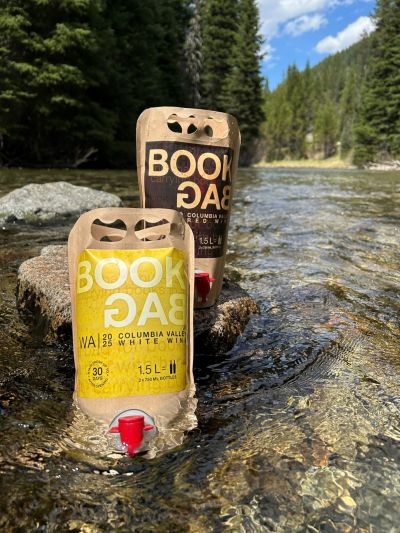
The latest entrant into the bag wine category in the Northwest comes from J. Bookwalter Winery. Bookwalter recently launched its gotta-love-the-name Book Bag wines. The inaugural offerings include a red and white wine in a 1.5L pouch. A rosé is coming.
“It’s meant to be fun, accessible, and easy-drinking, and you might as well have some whimsy to it as well,” Bookwalter director of winemaking Cameron Parry says of the name.
The idea for the Book Bag came from a desire to offer wine in a package better suited to camping, boating, tailgating, or anywhere that glass can be problematic. The Book Bag is fully waterproof, ideal for chilling in a river or throwing in a cooler.
Bag wines can also be perfect for home use. Ever want a glass of wine but you don’t want to open a full bottle? Voilà! Bag wine keeps well for an extended period in the fridge. Equally important, wines in alternative packages like this are much more environmentally friendly than glass bottles.
“The Book Bag has a lower footprint, and it weighs a lot less,” Parry says. Two wit, a full nine liter case is only 21 pounds compared to 35 to 45 pounds for wine in glass bottles.
Of course, it’s always what is in the bottle or bag that’s most important. Bookwalter, however, has a history of overdelivering on price, from its Notebook to Readers wines and beyond. The suggested price for the Book Bag is $24.99, and it is already available in some local and national stores. (Look for a review of the Book Bag wines shortly.)
Another recent entrant into the bag wine category is Rôtie Cellars. The winery’s Walla Walla Valley 2025 Syrah Rosé is now offered in a three liter bag.
“The Rôtie team takes wine seriously, but not the rules around how you drink it,” says Taylor Knight of Taylor Knight Wine Marketing. The Rôtie rosé is available at both Rôtie’s Walla Walla and Seattle tasting rooms. (Call first to check on availability. Read a recent review of this wine here.)
There are a number of other wineries in the Northwest making wine in bags. They include but are not limited to The Walls, Winter’s Hill, Amos Rome, Gilbert Cellars, and Brainstorm Cellars. Add your favorite in the comments.
Meanwhile Yakima Valley’s Airfield Estates recently launched a series of low calorie, lower alcohol wines called Glider. To get there, the winery is leveraging its old vines.
“I’ve always been a fan of low alcohol, fresh, aromatic whites,” says Marcus Miller, managing member of Airfield Estates. “I wondered if there was a way we could use our old vines to make a dry style of some of these low alcohol wines I’ve been enjoying across the world. The old vines develop wonderful flavors before sugar spikes.”
To achieve this, Miller spent time in the vineyard so that he could pick at the earliest point possible.
“As soon as I saw Pinot Gris flavor, Sauvignon Blanc flavor, and Chardonnay flavor across 90% of the berries, I said let’s bring it in,” Miller says.
The Glider wines clock in at 9% alcohol. As one would expect picking so early, the concentration is considerably lighter. At the same time, these wines deliver a lot of enjoyment aromatically and on the palate.
Meanwhile, wineries are making an increasing number of no alcohol offerings as well. I recently reviewed a lovely Okanagan Valley no alcohol sparkler from Evolve. I’ve also written recently about a no alcohol wine alternative, MaraBela tea.
Overall, the changing landscape in the wine industry is forcing wineries to be creative in what they deliver and how the deliver it. The result is a boon for consumers.
Image courtesy of J. Bookwalter Winery.
Do you enjoy Northwest Wine Report? If you do and haven’t already, please subscribe. Northwest Wine Report is 100% subscriber funded. To those who have subscribed, thank you! You power this site.



Leave A Comment