




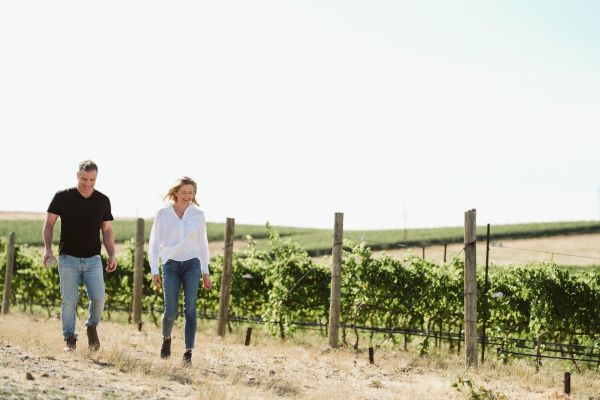
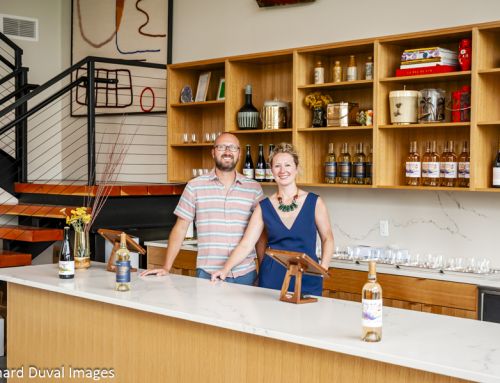
Peter and Kelsey Devison, Devison Vintners by Victoria Wright
Editor’s Note: This is the first in a series of articles about Sauvignon Blanc, the 2026 Northwest Wine Challenge variety.
“I don’t understand why people think I know how to make Sauvignon Blanc. I don’t!” insists Peter Devison, owner and winemaker at Devison Vintners in Walla Walla.
All modesty aside, the Devison Sauvignon Blanc speaks for itself. It is unquestionably one of the highest quality Sauvignon Blancs being made in the U.S. To get there, Devison went on a journey that very much mirrors his own as a winemaker.
A love of Sancerre
Devison’s love of Sauvignon Blanc dates back to his days as a sommelier in Vancouver, British Columbia. He was drawn to Sancerre, Sauvignon Blanc from France’s Loire Valley.
“I think Sancerre is one of the best white wines of the world,” Devison says. “Other than White Burgundy, I think it is the best white wine in the world.”
For Devison, Sancerre possesses the three things that he looks for in wine: terroir, texture, and tension. At its best, Sauvignon Blanc delivers all three.
“It speaks to the soil,” Devison says of Sauvignon Blanc from Sancerre. “It has this beautiful oyster shell, crushed rock tension, but it also has this round texture.”
Ironically, this is not the Sauvignon Blanc that Devison learned how to make as a young winemaker in New Zealand and in Australia. There, juice was “ultra-fined,” a process of removing solids during fermentation and aging. The intention was to both to remove any potential bitterness or astringency and to achieve an expression of Sauvignon Blanc for which New Zealand in particular has become famous for.
“The idea was to push the aromatic expression of the variety at all cost. Nothing else mattered,” Devison says. “Then when I came to Washington, I tried that style, and the wines were just very boring and cookie cutter.”
Finding his own style
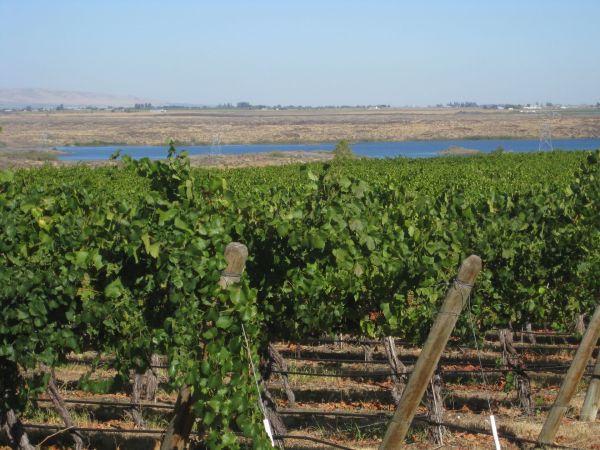
Evergreen Vineyard, Ancient Lakes of Columbia Valley appellation
Devison started to find his own style of Sauvignon Blanc while working as white winemaker at Precept. (It was these Sauvignon Blancs that put Devison on my radar screen.) The lessons, however, did not come easily.
One vintage, Devison was working with a vineyard where the Sauvignon Blanc grapes had a very low pH and very high acidity. As he waited for the acids to drop, the sugar kept climbing and climbing.
Finally, Devison’s hand was forced. He picked the grapes.
In the winery, Devison watered the wine back to reduce the potential alcohol. To his surprise, the resulting wine was beautiful. It was a revelation.
“What it taught me was, don’t pick on acids,” Devison says. “Pick on flavor. If you pick on numbers, you make wine by numbers. You can lose out on something that’s really, truly great.”
As Devison moved on to become winemaker at EFESTÉ in Woodinville in 2012, he was given the opportunity to work with Evergreen Vineyard, the site he continues to work with today. Located in the Ancient Lakes appellation, Evergreen has soils with high levels of calcium carbonate, or caliche. This gives the wines a distinct minerality. The vineyard is also known for producing wines with bracing acidity.
Devison says that it took him several years to understand Evergreen.
“I think that it was being confident about what I wanted to achieve,” Devison says.
Turning 180 degrees
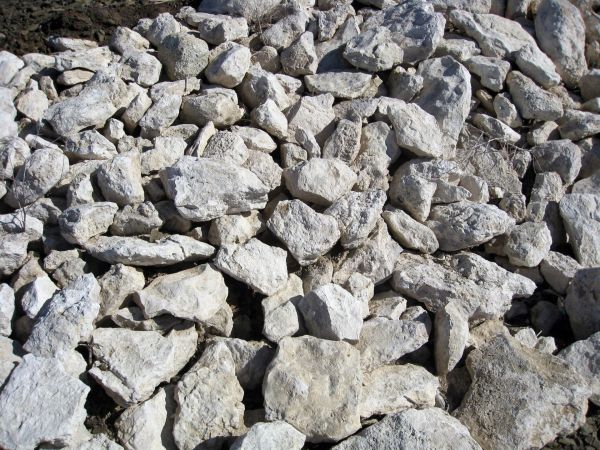
Calcium carbonate (caliche) encrusted rocks at Evergreen Vineyard
Another important factor to Devison’s evolution making Sauvignon Blanc came from fermenting with ambient, or so-called native, yeast. Devison had experimented with native fermentation at Precept. At EFESTÉ, former winemaker Brennon Leighton, who recruited Devison, was fully committed to it.
Devison’s first year at EFESTÉ, he did a trial. He fermented some Sauvignon Blanc with commercial yeast and the rest with ambient yeast. The results were clear.
“The native was hands-down better,” Devison says.
Another critical piece to Devison’s Sauvignon Blanc journey is antithetical to how he started out making the variety. He does not fine the fermenting juice and leaves the juice on solids from the grapes.
“It’s 180 degrees flipped from what I did in New Zealand and what I did at Precept,” Devison says. “A lot of it has to do with site. Having those solids with a high acid, low pH vineyard with that caliche, like Evergreen, you want texture, and the solids definitely add that. We also have great phenolic ripeness in Washington.”
Some of the grapes are soaked on skins and then pressed and fermented. Some are fermented on skins all the way through fermentation. Finally, some go straight to press and are subsequently fermented, as is traditional with white wine.
The final piece is fermenting in barrel. This helps provide additional textural richness.
Searching for a better Sauvignon Blanc
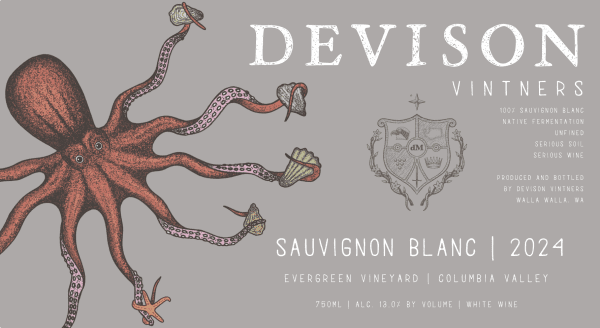 Put it all together and the Devison Evergreen Vineyard Sauvignon Blanc is distinctive from everything else being produced in the Northwest let alone North America. The wine is full of citrus and tropical aromas and flavors, while the palate provides texture, tension, electric acidity, and abundant minerality.
“To me, the wine is less about the perfumed, punchy New Zealand style and more in the mineral, citrus, herbal side of Sancerre,” Devison says. “It’s something so cool about Sauvignon Blanc, where you get that grassy, herbal, crushed rock, lemon-lime, Smarties characteristic, and then you get all this richness. That, to me, is the true version of Sauvignon Blanc.”
By his own admission, Devison’s Sauvignon Blanc is “demanding.” It is also not a wine that everyone will like, with some finding it too tart. Adding to the challenge, it drinks best at the cooler end of a red wine temperature, allowing the aromas to open and the textural richness to blossom.
While there’s no question Devison has made his mark with Sauvignon Blanc, he says that the wine remains a work in progress. The inspiration remains his favorite wines from Sancerre.
“I don’t think I’ve gotten there yet,” Devison says. “I’m gonna die trying.”
To receive notifications about new articles via email, click here.
Do you enjoy Northwest Wine Report? If you do and haven’t already, please subscribe. Northwest Wine Report is 100% subscriber funded. To those who have subscribed, thank you! You power this site.

Leave A Comment