




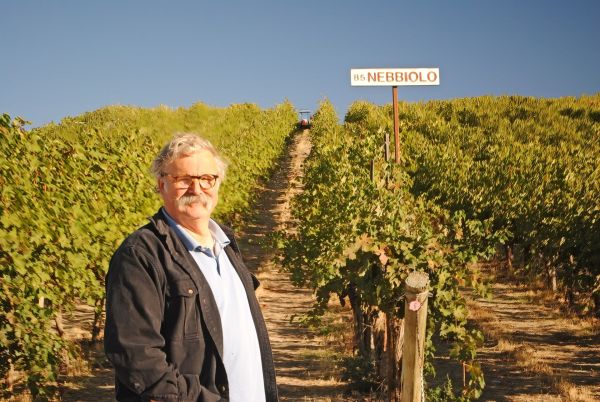
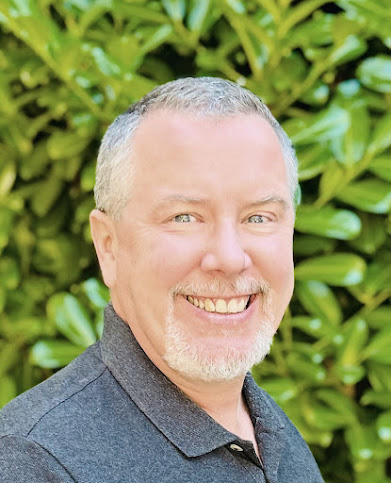
Peter Dow at Red Willow Vineyard, Yakima Valley
Peter Dow, founder of Café Juanita in Kirkland, Washington as well as Cavatappi Winery and Cavatappi Distribuzione in Seattle, passed away December 22nd after a series of stroke-related issues. He was 80 years old.
“His impact from the restaurant side to distribution and to winemaking is significant every step of the way,” said Mark McNeilly, founder and winemaker at Mark Ryan Winery in Woodinville and a close family friend.
Dow started Café Juanita in 1978. With homemade pasta and Italian-inspired fare that changed nightly, the restaurant was then and remains today highly regarded in the Pacific Northwest. (Dow sold Café Juanita in 2000.)
At Cavatappi Winery, Dow championed Italian and other varieties. Red Willow Vineyard in Yakima Valley planted Washington’s first Nebbiolo in 1985 at Dow’s encouragement, kicking off varietal experimentation at the vineyard that profoundly impacted the Washington wine industry.
Cavatappi Distribuzione, Dow’s importer/distribution company, championed Italian and other world wines and included prominent names, such as Kermit Lynch and Terry Thiese.
“[Cavatappi] occupied a position of prominence in the market that easily outpaced their size,” said Paul Zitarelli of Full Pull Wines, a prominent Seattle area wine retailer.
Overall, Dow occupied the exceptionally rare space of simultaneously owning a restaurant, winery, and distribution company. His family noted, however, that he was a “discourager to aspirants to any of the above.”
An unconventional path
Peter Sands Dow was born April 14, 1945 in Seattle. A third-generation native of Seattle, he was the child of Pierre Dow and Margery Dow (née Lewis). Dow grew up in Seattle’s Mount Baker neighborhood. He was a graduate of Franklin High School.
Though he never finished a degree, Dow took classes at both Central Washington University and University of Oregon. Dow served in the Coast Guard from 1970 to 1971. Dow met Margaret “Peggy” Sheehan on a blind date in 1977; they married in 1979 on Bainbridge Island.
Dow’s turn to launching an influential restaurant was unconventional. He became a waiter after struggling to sell life insurance. Dow worked as a cook at an Alaska cannery and at Kentucky Fried Chicken in Vail, Colorado.
Dow interned at Hindquarter Restaurant in Leschi. He also marketed wines for Boordy Vineyards, a Maryland-based winery still in operation that had a Yakima Valley outpost in the 1970s.
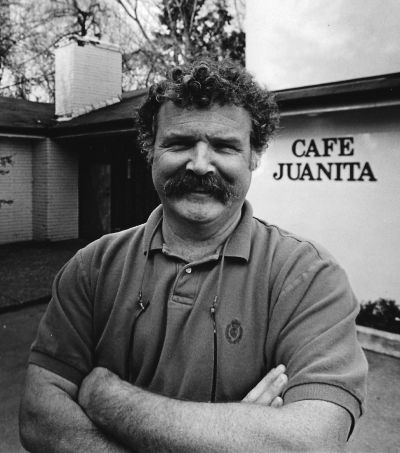
Peter Dow, Café Juanita
Early forays in the restaurant world by Dow included Leschi Fish and Chips, Pier 54 7/8 on Elliott Waterfront, and Gordo’s at Shilshole, a burger joint whose motto was “The best thing to happen to buns since Levi’s.”
Dow originally founded Café Juanita in 1978 with the intent of serving breakfasts, burgers, and sandwiches. However, things quickly took a considerably different turn.
A love of Italian food and wine
On an extended skiing trip through the Italian Dolomites, Dow became interested in Italian food. Inspired by the cuisine, Dow subsequently made dinners at Café Juanita with an Italian influence.
“If you order Béarnaise sauce in a dozen different French restaurants, you will always get the same sauce every time. But if you try lasagna in as many Italian cafes, the sauce will vary from kitchen to kitchen, depending on the imagination and experience of the chef,” Dow told food critic Lila Gault in 1978. “That’s why Italian cuisine captured my enthusiasm.”
That year, Gault wrote that Café Juanita made “a strong bid for the best Italian restaurant in town.” With the review, the once-struggling restaurant was off to the races.
“Once word spread about the incredible Italian food coming out of that tiny house, you’d see the fanciest cars in Seattle lined up in the parking lot,” said Madeline Dow Pennington, one of Dow’s two daughters. “The reputation really grew.”
Restaurant as a personal statement
Dow’s tiny restaurant sat a maximum of 24 people. From its inception, Café Juanita was unconventional. There were no menus. Offerings were written each night on a central chalk board. Servers were tasked with verbally delivering a full description of the menu to diners. Entrees included everything from fresh fish to pollo di pistachio and veal marsala. All pasta was homemade.
“I’d always wanted to do a restaurant that was a personal statement,” Dow told the Seattle Post-Intelligencer in 1998.
Dow moved the restaurant a short distance away to its current location in 1980. Café Juanita is located in a former residential home along Juanita Creek.
At Café Juanita, Dow started out as owner and chef. John Neumark subsequently served as executive chef and then chef and general manager. Dow sold the restaurant in 2000 to Holly Smith, who continues to own it today.
“Café Juanita was a fresh take on what American Italian food was,” said restaurateur Tom Douglas, a close family friend. “After taking my first trip to Italy, I also recognized that what I was getting at Café Juanita was much closer to what was on the tables of Alba, Tuscany, and all the places that we ended up visiting together over the years.”
Café Juanita continues to be one of the Seattle area’s top restaurants decades later.
A spark for varietal exploration
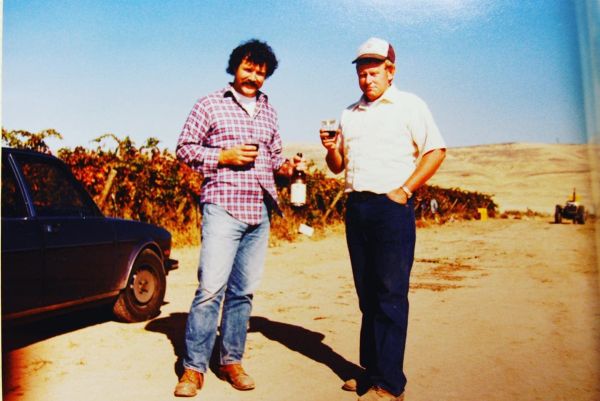
Peter Dow (left) and Mike Sauer at Red Willow Vineyard
Dow had been making wine at home since the late ‘70s. Dow was taken by the small trattorias that poured their own “house made” wine. His travels had also given him a particular love of Italian wine.
It was for these reasons that in 1983, during harvest no less, Dow arrived unannounced at Red Willow Vineyard.
“I was in the middle of picking Cabernet Sauvignon,” grower Mike Sauer recalled. “Guy shows up, he gets out of the car with a bottle of Barolo and two wine glasses and introduces himself as Peter Dow from a restaurant called Cafe Juanita, and says he wanted me to plant Nebbiolo for him.”
After learning about the great wines of Northern Italy and Café Juanita’s outsized reputation, Sauer agreed to plant Nebbiolo for Dow. After propagating vines, Sauer planted an acre of the variety in 1985. It was surely one of the earliest custom plantings for a winery in Washington.
Red Willow would go on to pioneer a number of other varieties in the state. Most notably, when Columbia Winery winemaker David Lake heard about Red Willow planting Nebbiolo for Dow, he encouraged Sauer to plant Syrah. Red Willow planted Washington’s first Syrah vines in 1986. Today Syrah is Washington’s third most-produced red variety. (Nebbiolo remains a relatively rare variety in Washington.)
“I would attribute Peter as being the spark that started Red Willow Vineyard experimenting with so many varieties,” said Sauer, who described his friendship with Dow as a “42 year adventure.”
Making and distributing wine
Dow bonded Cavatappi Winery in 1984. After planting Nebbiolo at Red Willow, Dow and his family took three months off from the restaurant to learn about winemaking with Guido Rivella, the winemaker at the iconic Italian winery Gaja.
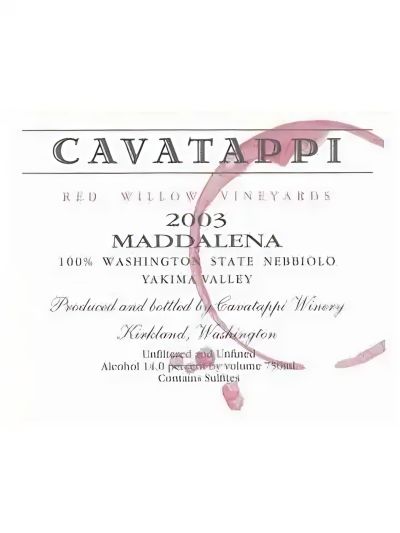
The following year, Cavatappi made its first Nebbiolo from Red Willow Vineyard fruit. Dow originally ran Cavatappi Winery from the basement of Café Juanita. The wines were sold at the restaurant and later through distribution and retail. The Cavatappi labels were simple and eye-catching – a wine glass stain and wine drops on a white background.
“That represented Peter’s attitude,” said Bob Betz, founder of Betz Family Winery in Woodinville, who first met Dow in the mid-‘70s. “This is part of life. This is enjoyment. This is pleasure. Don’t get so caught up in it, and Peter reflected that in all aspects of the business.”
Dow launched Cavatappi Distribuzione in 1995, aiming to import and offer through distribution some of the wines he had become familiar with in his travels to Europe. The Cavatappi portfolio came to offer some of the best-in-class wines from around the world and reflected Dow’s love of Northern Italian wines. Dow, meanwhile, was omnipresent in the industry.
 “I don’t think that you could have been in the wine industry and not known Peter Dow, especially in the late ‘90s and early 2000s,” said Ben Smith, owner and founder of Cadence Winery in Seattle.
Smith was one of a number of people who travelled to Europe with Dow over the decades for his distributor trips.
“It was clear that they loved Peter,” Smith said of the producers they met together. “It was more than just a business relationship. For Peter, it was part of his blood it seemed like, and people responded to that.”
Fueled by battles
Among Dow’s biggest accomplishments was owning and operating a restaurant, winery, and distribution company simultaneously. This put him squarely in the crosshairs of regulators, as it violated what are referred to as ‘tied house’ laws.
“It was a lot of battles, but truthfully, that’s what fueled him,” his daughter Madeline said. “He felt so passionate about how antiquated these laws were.”
Both of Dow’s daughters work in the wine industry and are married to people in the industry as well. They were surrounded by international influences from a young age, as their father cooked dinner for visitors.
“It felt like once a week there was a foreign winemaker coming through our home,” said Dow’s daughter Molly Scott. “It wasn’t until Madeline and I grew up and got into the industry ourselves that I realized that they were household names.”
In the aughts, Dow served two three-year terms on the board of the Washington Wine Commission, the state body charged with promoting Washington wine. (Full disclosure: I have consulted for the Commission since 2013.) He was a consistent champion for Washington wine.
“He was able to do things and see things, maybe that people hadn’t done before, or be part of a movement that hadn’t happened before,” Betz said. “And nothing got in this way.”
A Renaissance man, sans filter
Dow suffered strokes in 2010 and 2011. In 2016, Dow partnered with Precept Wines on Cavatappi Winery. He subsequently sold Cavatappi Distribuzione to Southern Wine & Spirits, where it remains as a subsidiary.
In addition to a love of Italy, wine, and the restaurant industry, Dow’s interests were diverse. He was an avid fisherman and reader. He was also a fan of Formula 1 racing and of music.
“He was a renaissance man without a filter,” said Betz. “There was never a filter.”
“Peter just was a force,” said Douglas. “I think people want to pigeonhole lives because he was in the wine business or whatever, but the breadth of his purpose, I think, was something that I’ll take away from our relationship.”
Dow was also known for his wit and repartee.
“Peter said the most outrageous, funny, poignant things I’ve ever heard,” said McNeilly, who first met Dow decades ago while working as a distributor. “You had to be prepared for a Peter Dow conversation, not only for content but for your ability to give it back and make sure it was par for the conversation.”
Peter Dow is survived by wife Peggy; daughter Madeline Pennington (Ryan); daughter Molly Scott (Ryan); and grandchildren Reese, Jack, Peter, and Charlie. He is also survived by sister Katie Chace (Tony), half-brother Howard Gilbert (Cecily), half-brother Bruce Dow and half-sister Barb Field (Brad).
Images of Peter Dow courtesy of the Dow family.
Northwest Wine Report is wholly subscriber funded. Please subscribe to support continued independent content and reviews on this site.
To receive articles via email, click here.
Such an incredible individual and life lived. Thank you for sharing this.