




 It’s time to focus on variety and appellation rather than the state
Washington state is not associated with a single variety the way that Napa Valley is for Cabernet Sauvignon or Willamette Valley is for Pinot Noir. Some say that Washington’s lack of a “signature variety” makes it harder for trade and consumers to understand the state and therefore promote the region.
However, I believe that Washington growers, winemakers, and wine lovers should abandon the idea that there will ever be a signature variety for the region. Instead, the focus should be on promoting specific varieties from specific appellations.
Wine is all about specificity. If one were asked what the signature variety is of, say, Italy, any wine lover would balk. Asking what the signature variety is of California would seem equally silly.
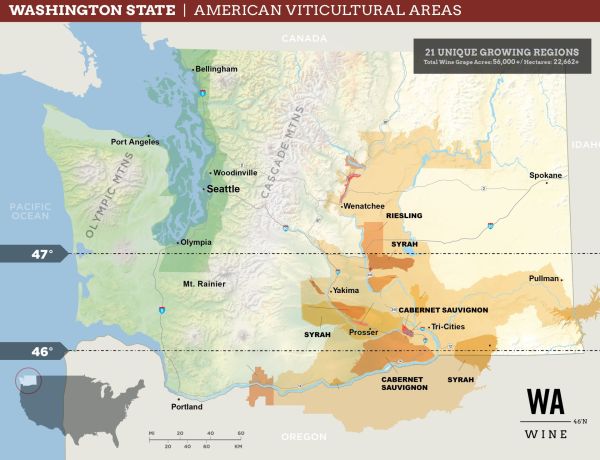
Washington state is no different. The Columbia Valley, Washington’s largest growing region, is far too large – 11M acres – to ever be defined by a single variety.
A better question to ask is what the signature varieties are of the Columbia Valley’s smaller, nested appellations. This is actually rather easy for a handful of them.
Here’s a list what I consider to be their signature variety for six Columbia Valley appellations, based on my tastings over the last 25 years.
Red Mountain: Cabernet Sauvignon
Cabernet Sauvignon is king on Red Mountain. The variety makes up over 60% of plantings. Red Mountain Cabernets are known for their ripe fruit, firm tannic structure, and excellent aging potential. A variety of factors contribute to this, including heat, wind, and soil. Other varieties do well on Red Mountain, but none excel in the same way that Cabernet Sauvignon does.
Honorable mention: Cabernet Sauvignon, Merlot, and Cabernet Franc-based blends.
Horse Heaven Hills: Cabernet Sauvignon
The Horse Heaven Hills had its first grape vine plantings in 1972 at what is now Champoux Vineyard. Since that time, the area has firmly established itself as Cabernet Heaven. While Red Mountain Cabernets are known for their firm tannins, Cabernets from the Horse Heaven Hills are identified by their powdery, fine-grained tannins due to a combination of heat, wind, and other factors.
Walla Walla Valley: Syrah
Syrah is the star in Walla Walla Valley. Valley Syrahs are known for their earthy and savory aromas and flavors. Many of these wines, of course, come from the Rocks District of Milton-Freewater, a nested appellation within the valley. However, given restrictions in federal labeling laws, most wines from the Rocks District are and will continue to be labeled as Walla Walla Valley.
While Syrah is no doubt the standout in the valley, I personally think of the Walla Walla Valley as a collection of areas. Over time, additional appellations will surely be added. I expect that each might have their own signature variety.
Honorable mention: Merlot, Cabernet Franc
Yakima Valley: Syrah
One could argue that the Yakima Valley, at 665,600 acres, is itself too large to be considered for a single variety. Still, Syrah has distinguished itself, from Boushey Vineyard to Red Willow Vineyard and beyond. The wines provide a compelling mix of fruit and savory aromas and flavors, balanced with the Columbia Valley’s freshness and vibrancy.
Royal Slope: Syrah
It’s clear that something special is going on with Syrah, and, to an extent, other Rhône varieties, on the Royal Slope. Royal Slope Syrahs have a strong savory aspect similar to the Rocks District of Milton-Freewater but without the high pH that gives those wines their distinctive feel. I expect more winemakers to explore the possibilities in the region in the future. Overall, a large number of varieties have potential in this region, but the Syrahs have already proven themselves to be distinctive.
Honorable mention: White Rhône varieties
Ancient Lakes: Riesling
Riesling is grown all over the broader Columbia Valley, but one appellation in particular stands out: the Ancient Lakes. Riesling from this area, and in particular Evergreen Vineyard (itself a collection of sites), is known for its lemon-lime and peach aromas and flavors and vibrant acidity. The soils are full of caliche, a calcium carbonate deposit, that lends a mineral character to these wines.
* * *
Washington has 21 appellations, yet I have only listed six here. There are three main reasons that there aren’t more appellations listed.
First, many of the state’s appellations are recently minted. In this way, we are just starting to see appellation-designated bottles.
Second, a number of regions are also recently planted. What variety expresses itself best in the area is still to-be-determined.
Finally, many wineries label their wines with the broader Columbia Valley designation, even if it comes from a nested appellation. This makes it harder to determine specificity.
Note that associating an area with one particular variety is not to say that only that variety grows well there. For example, Savennières makes wines other than Chenin Blanc that are quite lovely. However, Chenin is what that area is best known for.
Over time, this list will evolve and be further refined. While some argue that continuously adding appellations in the Columbia Valley makes things harder for people to understand, I personally believe that, in the long run, it will serve the state well.
Specificity of place is integral to wine. It’s time to focus on variety and appellation rather than the state.
Do you enjoy Northwest Wine Report? If you do and haven’t already, please subscribe SUBSCRIBE. Northwest Wine Report is 100% subscriber funded. To those who have subscribed, thank you! You power this site.

Excellent post. The strength of Washington is that we do not have a single grape that defines us. We have multiple varietals that excel.
I surely understand Red Mountain being known for Cabernet of the Sauvignon variety. However, I must lobby for Cabernet Franc. There are vanishingly few places in the world that allow Franc to ripen beyond overt green pyrazines and yet not be overblown, combining bright acidity, powerful tannins, crunchy sweet fruit and minerality. Red Mountain is truly a sweet spot for Franc.
OK, I’ll admit to a little bias :)
I enjoy the expression of Cab Franc from the Rattlesnake Hills AVA across multiple producers sourcing those grapes.